Kaen DaikoThe Flame Drum
火焔太鼓(かえんだいこ)
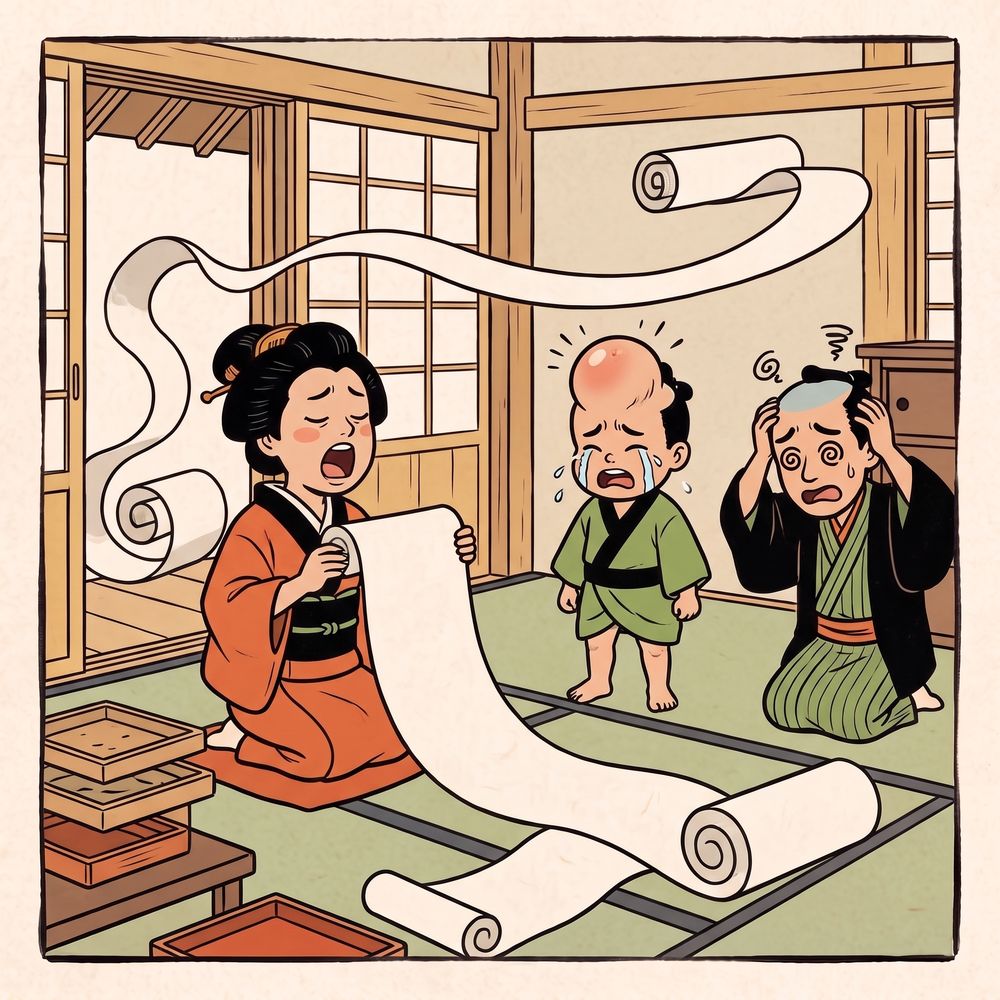
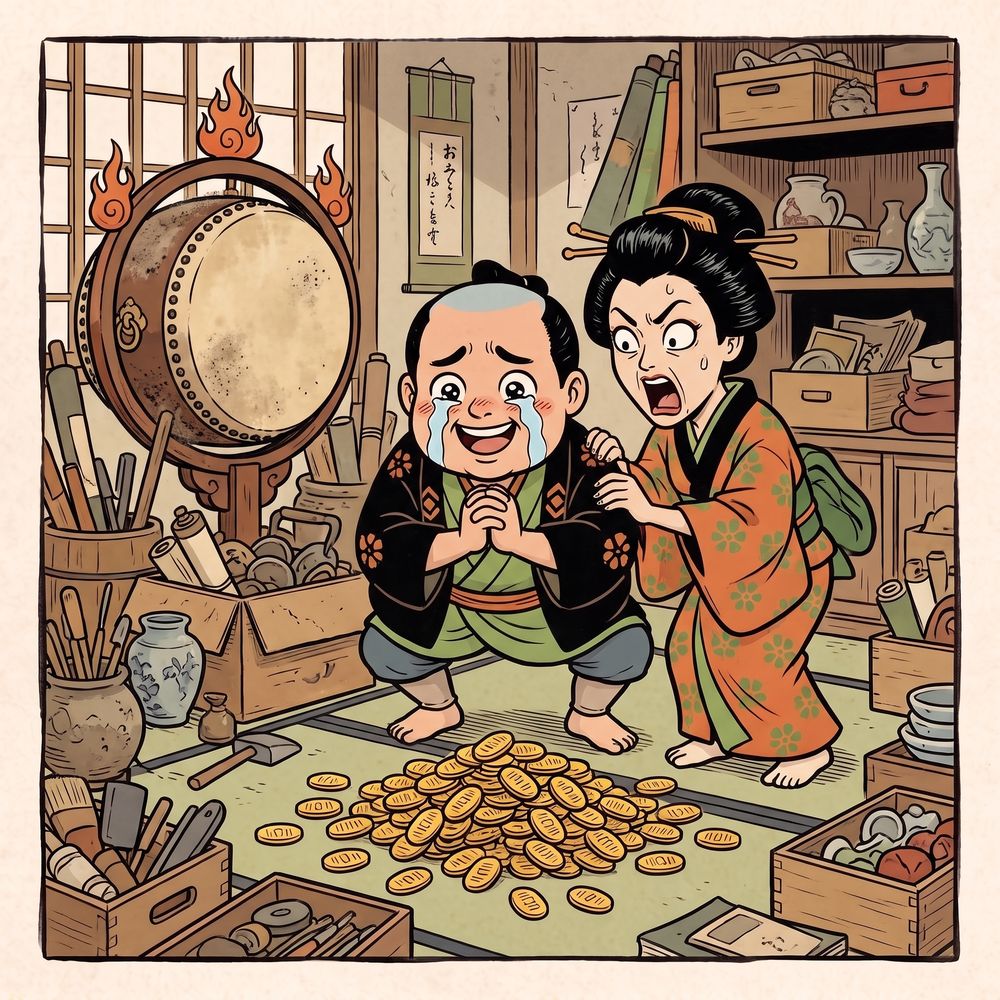
Jinbei runs a secondhand shop, but he's too good-natured to be any good at business. Today he's come back with a grimy old drum, and his sharp-witted wife gives him an earful. But when the shop boy beats it, the sound catches the ear of a passing lord, who orders it brought to his mansion...
The story
Jinbei, a secondhand dealer, is so honest that he keeps letting good deals slip away. The only reason his shop hasn't gone under is his shrewd wife. One day Jinbei comes back with a dusty old drum, and his wife lets him have it: what are you doing buying junk like that again?
While the shop boy Sadakichi is dusting off the drum out front, he starts banging on it for fun. A samurai rushes in and orders that the drum be brought to the mansion. The lord, Akai Gomon-no-kami, happened to pass by and liked the sound. Jinbei's wife frightens him: once the lord sees the real thing, he's sure to be furious. You'll end up tied to the pine tree in his garden, she says.
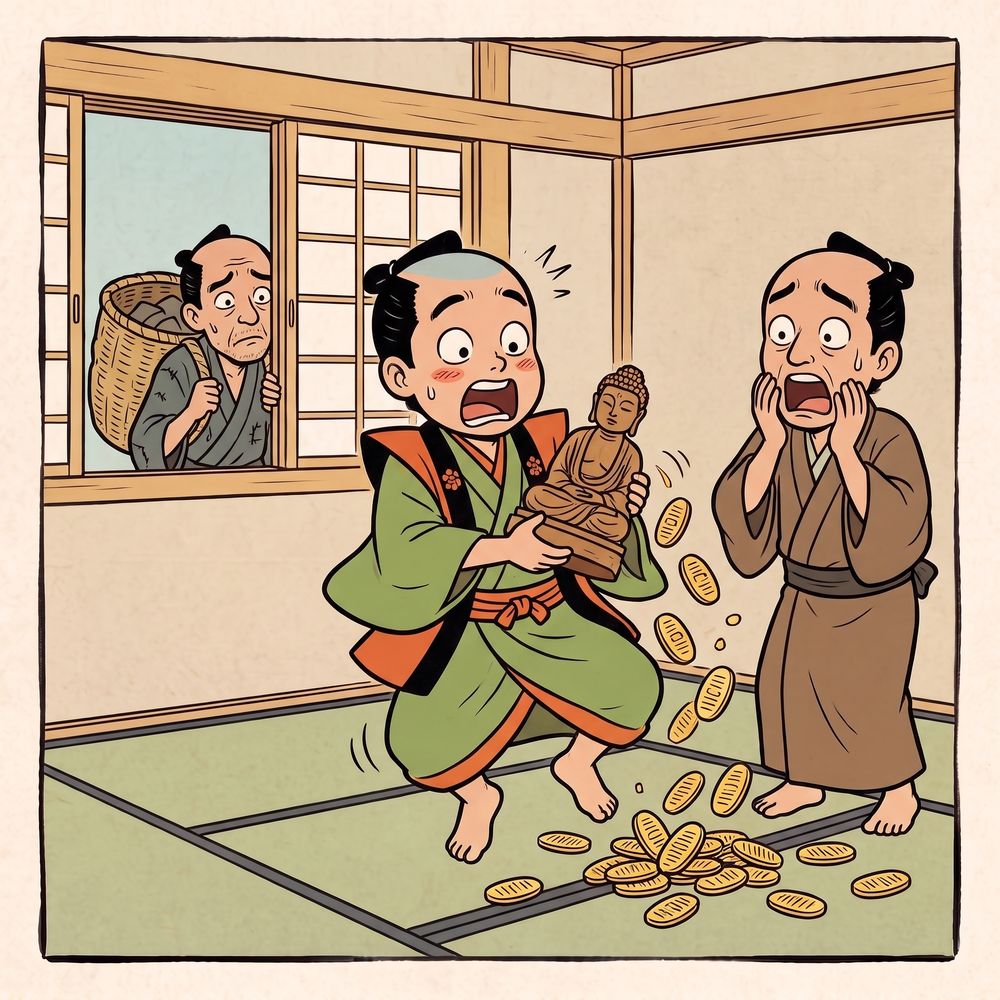
Trembling, Jinbei carries the drum to the mansion, and the lord loves it at first sight. It is a kaen-daiko, a flame drum, a treasure of the rarest kind. Asked to name his price, Jinbei agonizes and finally agrees to sell it for three hundred ryo. As he receives the gold koban coins, he bursts into tears and loses count partway through.
Back at the shop, Jinbei stacks up the coins to show his wife, and she finally believes him and is overjoyed. The two of them get completely carried away. From now on, says Jinbei, we'll only deal in things that make noise. Next, I'll stock a hansho, the fire bell from a fire lookout tower...
The sage the punchline, contains spoilers
Tap to reveal the punchline
“Not a fire bell! It'll all go ojan!”
In Edo, a single “jan” on the fire bell signaled that a fire was out, so “ojan ni naru” came to mean “to come to nothing” or “go up in smoke.” Some versions end differently: wanting to stock a drum, he's told “bachi ga ataru” (a drumstick will strike / you'll be punished), or wanting to stock a flute, he's told “pi-pi ni naru” (you'll be squeaking / you'll be broke).
Variations on the sage
The wordplay in the sage (the punchline) changes depending on what Jinbei wants to stock next. Each one is a pun linking an instrument to a common expression.
| Next purchase | Sage | The wordplay |
|---|---|---|
| Fire bell (hansho) | “It'll all go ojan.” | The fire bell rung to signal a fire was out, and “ojan,” meaning to come to nothing |
| Drum (taiko) | “Bachi ga ataru yo.” | Bachi, the drumstick, and bachi, divine punishment |
| Flute (fue) | “We'll be pi-pi again.” | The sound of a flute, and “pi-pi,” being hard up for money |
| Drum (Shinsho's New Year broadcast) | “Because it'll make money don-don.” | The boom of a drum, and “don-don,” money pouring in. A version changed into a happy ending |
Key scenes original dialogue written for this site
At the shop
- WifeAnother one of those sooty old drums? Who on earth is going to buy that?
- JinbeiNo, no, anyone with an eye for these things would know its worth.
- WifeIt's because people with an eye look at your stock that you keep losing money.
At the mansion
- RetainerHis Lordship is most pleased. Now, what is your price?
- JinbeiEr, my price, sir? Well, um, I'm not sure what my wife would say...
- RetainerYou can't name a price without asking your wife?
Counting the coins
- JinbeiA hundred and fifty ryo... a hundred and sixty... wait, where was I?
- (Stacking the coins in his palm, he wipes his tears on his sleeve.)
- JinbeiI've never touched this much money in my whole life.
This is not a transcription of any storyteller's performance. The plot and sage follow the classic version; the dialogue was written for this site.
Notable performers
- Kokontei Shinsho V1890–1973EdoInherited it from Sanyutei Yuza I, added gags and remade it substantially. It is said to have been the signature piece among all his signature pieces.
- Kokontei Shincho III1938–2001EdoShinsho's second son, and one of the performers with many surviving recordings.
- Gokaido Kumosuke VI1948–EdoA Living National Treasure. He sometimes performs it as Ninjo-banashi Kaen Daiko (Kaen Daiko as a human drama), told in a theatrical manner.
- Katsura Nanko III1951–KamigataIn 2016 he adapted it into kamigata (Osaka-Kyoto) style and performed it.