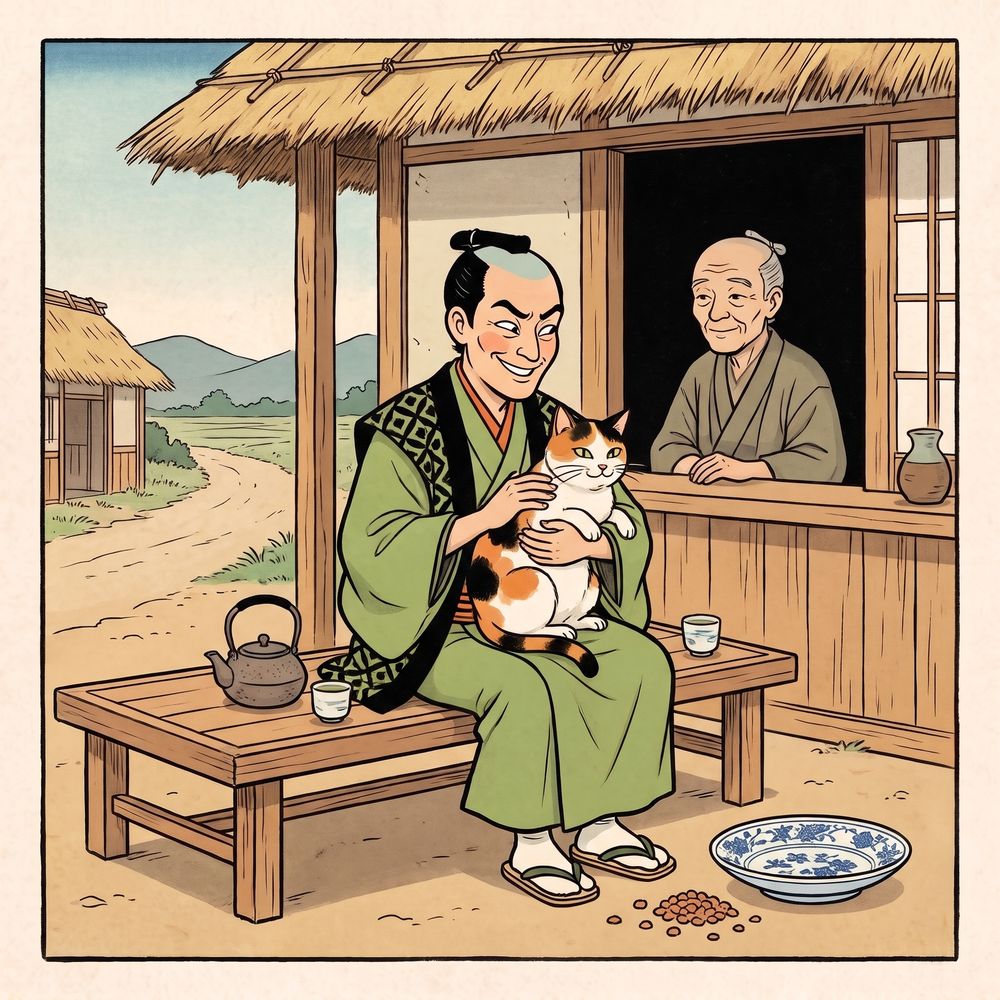
Neko no SaraThe Cat's Dish
猫の皿(ねこのさら)
A hatashi (an antiques dealer without a shop of his own), who travels the countryside buying antiques at rock-bottom prices, stops for a rest at a teahouse by the highway. Glancing over, he sees that the dish the teahouse cat is eating from is an extraordinary masterpiece. Pretending he has taken a liking to the cat, he tries to get the dish along with it, but the teahouse owner is one step ahead of him. It is a kokkei-banashi (comic story) packed with the fun of trickster outwitting trickster in a short space.
The story
A man works as a “hatashi,” buying and selling antiques without a shop of his own. He makes his living by traveling the countryside, buying antiques cheaply from owners who do not know their value, and selling them at high prices to collectors in Edo and Osaka.
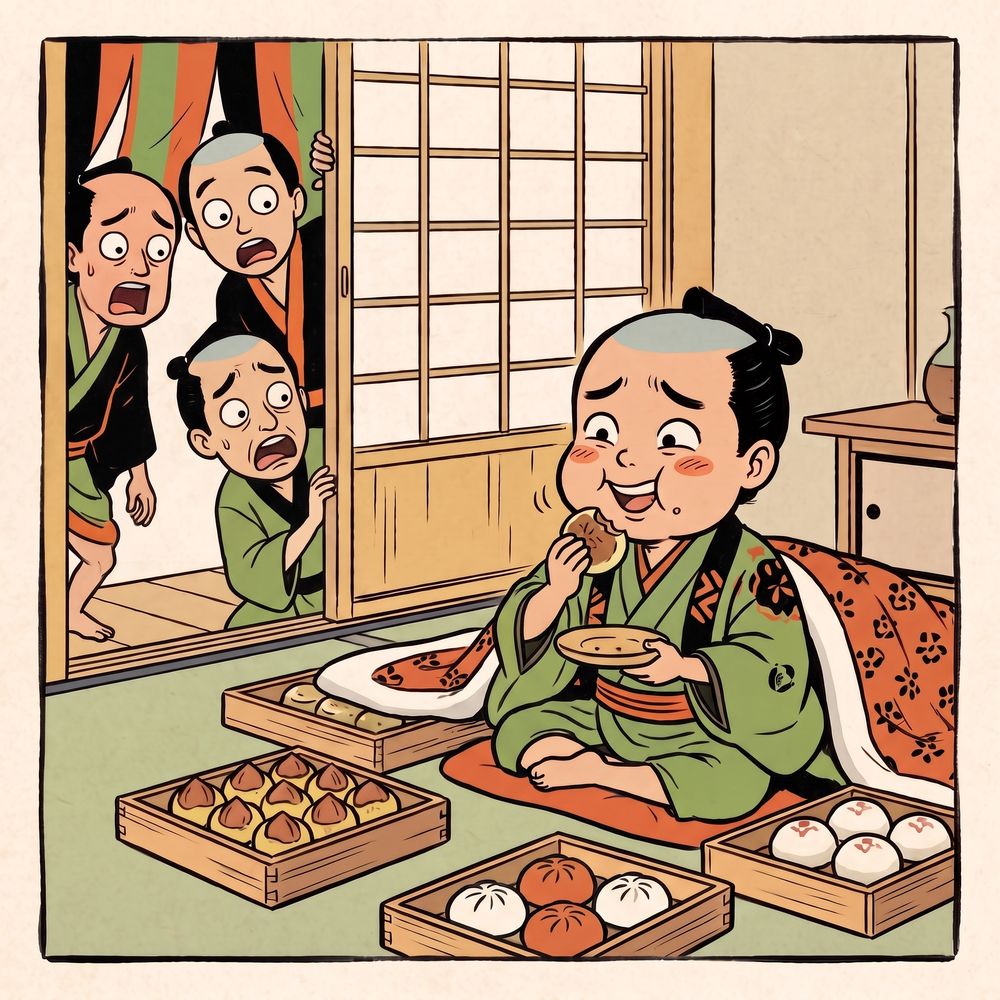
One day, while he is taking a break at a teahouse along the highway, a cat is eating its food in a corner of the shop. Looking closely at the dish, he sees it is a masterpiece known as “E-gorai no Umebachi.” Surely the owner of a country teahouse like this has no idea what it is worth.
The man picks up the cat and fusses over it, then offers, “I've really taken a liking to this cat. Would you let me have it for three ryo (gold coins)?” The owner readily agrees.
Delighted, the man says, “They say a cat won't eat if its dish is changed, so I'll take this dish too,” and casually tries to carry the dish off. But the owner stops him: “You're welcome to the cat, but that dish is worth three hundred ryo even at a bargain price. I can't sell it.”
Startled to learn that the owner knew its value all along, the man demands to know why, then, he feeds the cat from such a masterpiece.
The sage the punchline, contains spoilers
Tap to reveal the punchline
“Doing it this way, every now and then I sell a cat for three ryo.”
The owner knew exactly what the dish was worth and used it as the cat's food dish on purpose. Customers who spot the dish buy the cat at a high price just to get their hands on it. The sage (punch line) is that the hatashi, whose trade is to cheat people and buy things cheap, is neatly taken in by a country teahouse owner.
The original tale, and differences in performance
A very similar story can be found in reading matter from the Edo period. Even as a rakugo story, the prices and the piece of pottery change from performer to performer.
| What is known | |
|---|---|
| Shison Daikokubashira | An ukiyo-zoshi by Getsujindo. The original form of this story can be seen in “Ikkyu Osho” and “Tsume Kakusu Neko no Shokki,” both included in it. “Tsume Kakusu Neko no Shokki” is the fourth story in volume one (Hoei 6, 1709) |
| Oyama Dochu Hizakurige | By Ryutei Rijo. The second half of the third part (Bunsei 4, 1821) has a scene with the same idea, featuring a monkey and a chain |
| Neko no Chawan | When the story is performed under this other title, a small bowl appears instead of a dish |
| Differences by performer | The prices of the cat and the dish, and the units of money, vary by performer. Besides “E-gorai no Umebachi,” some performers make the dish “a fine piece of Kakiemon” |
Key scenes original dialogue written for this site
Spotting the dish
- Hatashi(Sipping his tea, he glances sideways at the corner of the shop.) ...Well, now. That cat's food bowl is no ordinary dish.
- (He sets down his teacup and changes only his tone of voice, making it relaxed.)
- HatashiMaster, that's a fine cat you keep. The coat, the face, everything.
- OwnerOh, it's just a common alley cat, sir.
Buying the cat
- HatashiThere, there, good kitty. Look, it's rubbing up against me. Master, this one's fallen for me. I'll give you three ryo. Won't you let me have it?
- OwnerThree ryo? That much, for one cat? ...Very well, sir, please take it with you.
- HatashiMuch obliged. And while I'm at it, they say a cat goes off its food when its bowl is changed, don't they? I'll take this dish along too.
- OwnerAh, no, sir. You're welcome to the cat, but that I can't sell.
The owner reveals his trick
- HatashiWhat, over one grubby old dish?
- OwnerNo, sir, that's a piece worth three hundred ryo even at a bargain price.
- Hatashi...So you knew. If you knew, why on earth are you feeding the cat from a dish like that?
- OwnerWell, sir, doing it this way, every now and then I sell a cat for three ryo.
This is not a transcription of any storyteller's performance. The plot and the sage follow the classic version. All lines were written for this site.
Notable performers
- Kokontei Shinsho V1890–1973EdoOne of the performers whose recordings survive. His performance was included in the first issue of the CD magazine Rakugo Showa no Meijin Kiwametsuki 72-seki (Rakugo: Great Masters of the Showa Era, 72 Definitive Performances).
- Kokontei Shincho III1938–2001EdoOne of the performers whose recordings survive. His performance at the Toyoko Rakugo-kai (a rakugo show series) was included in the CD magazine Rakugo Showa no Meijin Kanketsu-hen (Rakugo: Great Masters of the Showa Era, Final Series).