Hatena no ChawanThe “Hmm?” Tea Bowl
はてなの茶碗(はてなのちゃわん)
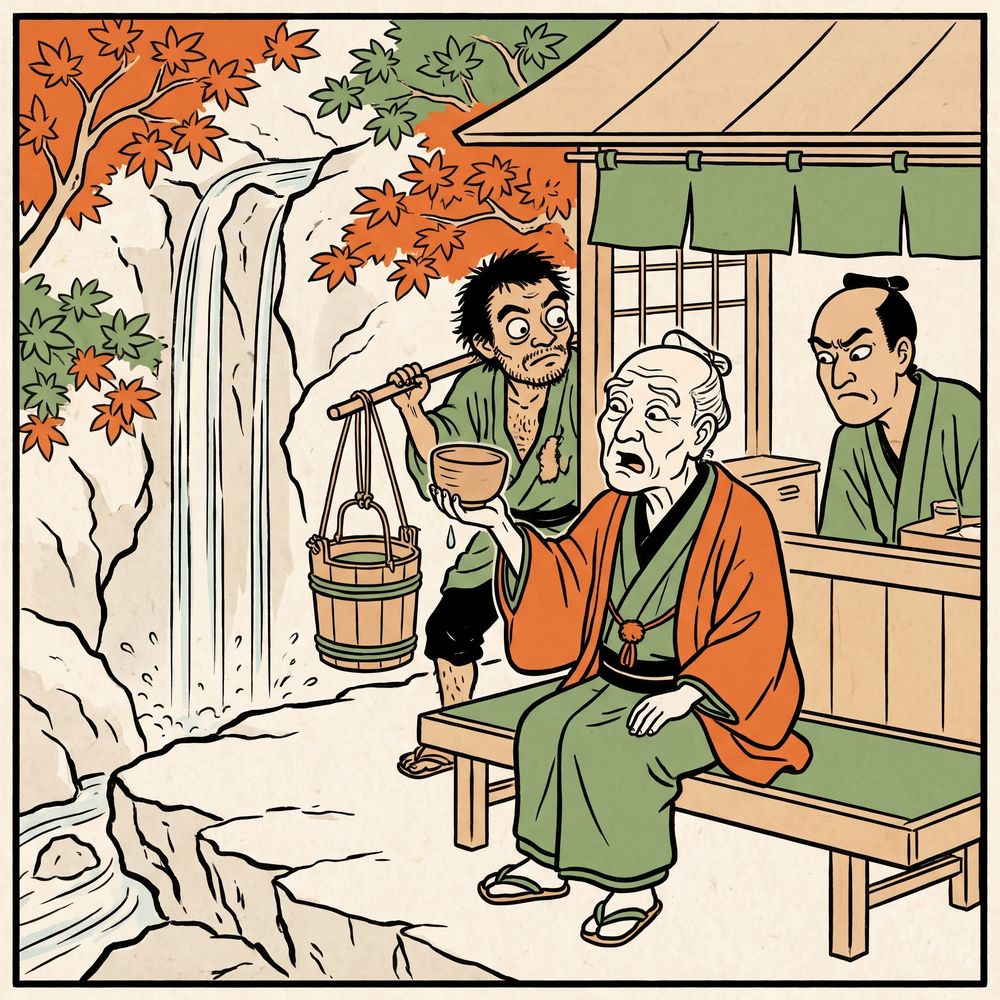
Beside the Otowa Waterfall at Kiyomizu in Kyoto, an oil seller from Osaka resting at a teahouse sees Kinbei, a famous Kyoto dealer in tea utensils known as “Chakin,” gaze at an ordinary tea bowl and tilt his head, saying “Hmm?” (hatena). If an expert puzzled over it, it must be a hidden treasure. So the oil seller gets the bowl for himself, but in fact it is just a bowl that leaks water though it has no cracks or chips. And yet this bowl goes on to gain a value no one could have imagined.
The story
A man born in Osaka makes his living in Kyoto carrying oil on a pole and selling it. While he is taking a break at a teahouse beside the Otowa Waterfall at Kiyomizu, Kinbei, the master of a well-known Kyoto tea-utensil shop known as “Chakin,” picks up one of the teahouse's bowls, looks it over again and again, tilts his head, says “Hmm?” and leaves.
If Chakin tilted his head over it, it must be very valuable. The oil seller asks the teahouse owner to sell it to him. The owner, thinking the same thing, refuses, but the oil seller pushes so hard that it is almost a threat, and in the end he buys the bowl for two ryo (gold coins).
The oil seller puts the bowl in a damask bag and a paulownia-wood box and takes it to Chakin's shop, offering it as “a piece worth a thousand ryo.” The head clerk won't take him seriously, and while the two are arguing, Kinbei, hearing the commotion, comes out.
According to Kinbei, the bowl has no cracks or chips, yet water drips out of it from somewhere. He only tilted his head because that seemed so strange; the bowl is not valuable at all. Feeling sorry for the crestfallen oil seller, Kinbei takes the bowl off his hands for three ryo and sends him away, urging him to work steadily so that one day he can go home and take care of his parents.
But the story gets around. The Kanpaku (chief adviser to the emperor), Lord Takatsukasa, sees the bowl and composes a poem about it, and as it spreads among the court nobles, even the emperor becomes interested. Water leaking from the bowl wets the hem of his robe, and the words “Hatena” in the emperor's own hand are added to its box.
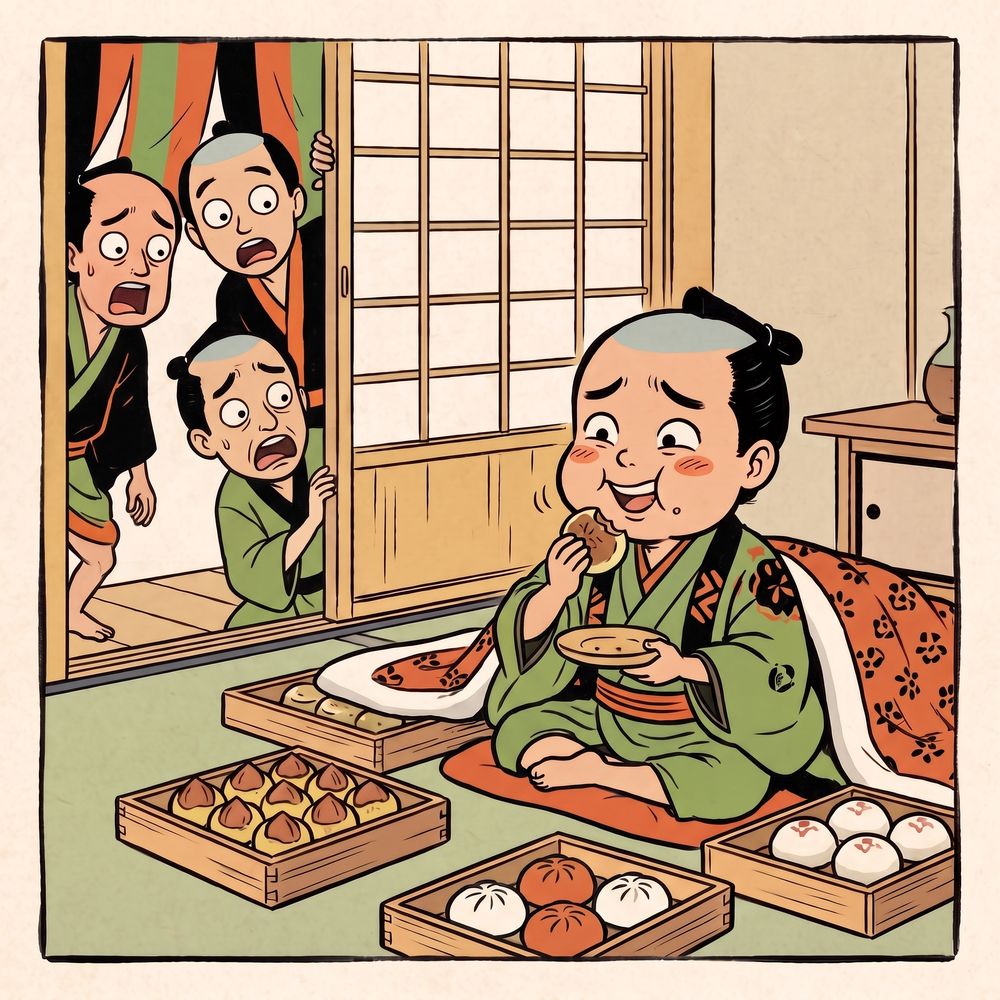
Now it is a treasure known throughout the land. Konoike Zen'emon, a wealthy Osaka merchant, buys the bowl from Kinbei in the form of keeping it in exchange for a deposit of a thousand ryo. Kinbei finds the oil seller and gives him half, five hundred ryo, telling him that the rest will go to charity and to a feast for the people of his shop. Some days later, the oil seller comes to Chakin's shop again, full of energy. This time, he says, he has “a deal worth one hundred and eight thousand ryo”...
The sage the punchline, contains spoilers
Tap to reveal the punchline
“This time I've found a water jar that leaks.”
It is the oil seller's hasty conclusion: if a leaking tea bowl is worth a thousand ryo, a leaking water jar should bring in far more. Just before the sage, there is a scene in which the oil seller leads the way as a water jar is carried into Kinbei's shop.
Hatena no Chawan in Kamigata and Chakin in Tokyo
This is originally a Kamigata story, and in Tokyo it is also performed under the title Chakin. Katsura Beicho III supposed that it was brought to Tokyo around the middle of the Meiji era, and in Tokyo it was described as the signature piece of Tachibanaya Enkyo IV. In Kamigata, Beicho is said to have revived it, and the rakugo writer Osada Sadao has said that it is “a story you could almost say (Beicho) created.”
| Kamigata: Hatena no Chawan | Tokyo: Chakin | |
|---|---|---|
| Main title | Hatena no Chawan | Chakin (also Hatena no Chawan) |
| The oil seller | A merchant from Osaka who carries oil around Kyoto and sells it | Changed to an Edo merchant, who talks almost like a craftsman |
| Location of Chakin's shop | Koromonotana (Katsura Beicho III's version) | Kiyamachi (Kokontei Shinsho V's version) |
Key scenes original dialogue written for this site
At the teahouse
- Oil sellerHey, old man, sell me that bowl, will you?
- Teahouse ownerOh no, I can't let that one go. It's a precious piece of ours.
- Oil sellerYou were just serving customers cheap tea in it!
- Teahouse owner...That's a different matter.
At the front of Chakin's shop
- Head clerkWe don't deal in this sort of article here. Please take it away.
- Oil sellerHow can you tell without looking? Open the box. It's worth a thousand ryo.
- KinbeiIt's awfully noisy out front. What's going on?
- Oil sellerAh, Mr. Chakin. It's that bowl you were tilting your head over at Kiyomizu.
Why he tilted his head
- KinbeiYou see, that bowl has no cracks or chips, and yet water leaks out of it from somewhere.
- Oil seller...Huh. It leaks.
- KinbeiI thought, how odd, and that's all I meant when I said “Hmm?”
- (The oil seller slowly lowers the paulownia box he was holding onto his lap.)
- Oil sellerMy two ryo, dripping away drop by drop...
This is not a transcription of any storyteller's performance. The plot and the sage follow the classic version. All lines were written for this site.
Notable performers
- Tachibanaya Enkyo IV1865–1912EdoChakin in Tokyo was described as his signature piece.
- Kokontei Shinsho V1890–1973EdoHe performed it under the title Chakin. One of the performers whose recordings survive.
- Katsura Beicho III1925–2015KamigataHe is said to have revived this story in Kamigata. Osada Sadao has said it is “a story you could almost say he created.”
- Kokontei Shincho III1938–2001EdoOne of the performers whose recordings survive.