Yadoya no TomiThe Lottery Ticket at the Inn
宿屋の富(やどやのとみ)
A man staying at a run-down inn brags wildly that he is enormously rich. The innkeeper takes him at his word and asks him to buy an unsold lottery ticket, so the man ends up handing over his last ichibu (one bu, a quarter of a ryo). Then, at the drawing in the shrine grounds, that ticket wins the top prize of a thousand ryo.
The story
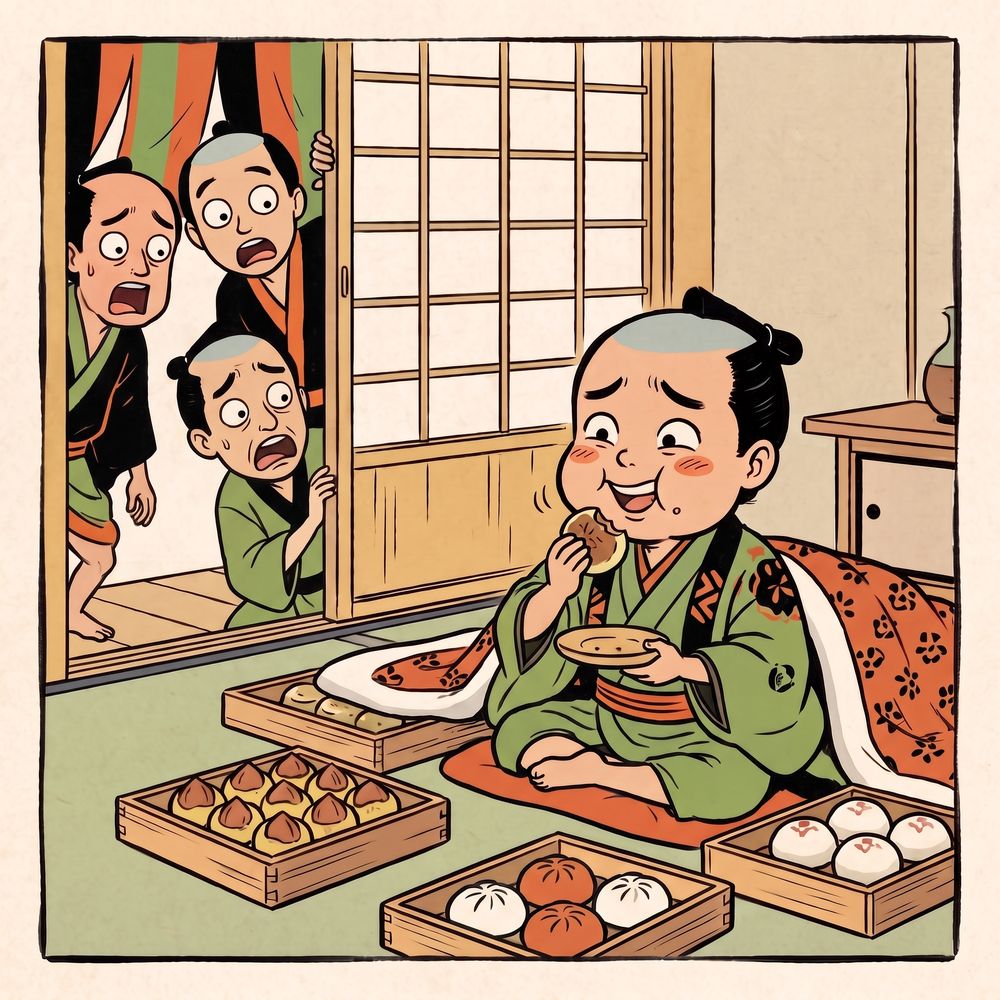
A man checks into a run-down inn in Bakurocho. When the subject of payment comes up, he starts claiming he is a tremendously wealthy man back home with hundreds of servants. He even says absurd things, like that he can see both Lake Biwa and Mount Fuji from his garden, but the good-natured innkeeper believes every word.
So the innkeeper asks him to buy a leftover lottery ticket for one bu. Having to keep up his act, the man can’t refuse. He generously promises to give the innkeeper half if it wins, then heads out. In truth he is flat broke, in town to try to scrape up some money, and he curses having his last bu taken from him.
He wanders over to the shrine grounds where the drawing is being held. Looking at the posted winning numbers, he finds his own ticket has won the top prize of a thousand ryo. Unable to stop shaking, he runs back to the inn, says he feels ill, and burrows under the futon.
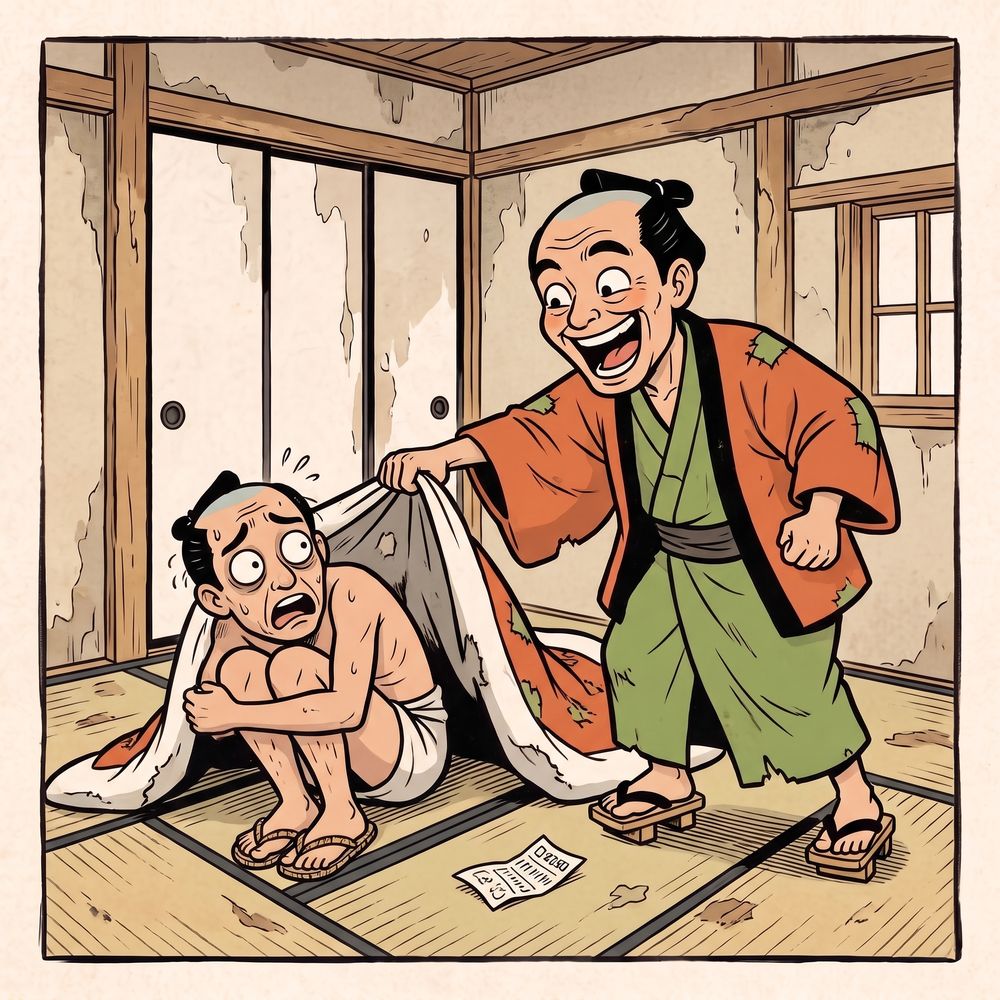
Before long the innkeeper learns that the ticket he sold has won a thousand ryo and goes into a frenzy. He rushes upstairs and calls to the man under the futon: you’ve won a thousand ryo, and they’re getting a celebration ready downstairs! The man scolds the innkeeper for coming into the room with his geta (wooden clogs) still on, but...
The sage the punchline, contains spoilers
Tap to reveal the punchline
The innkeeper pulls back the futon, and the guest is lying there with his zori (sandals) still on.
The sage (the punchline): the very guest who scolded the innkeeper for his geta had himself forgotten to take off his zori ever since he fled back to the inn. With a single detail about footwear, it shows that the seller and the buyer were equally beside themselves over the thousand-ryo win.
Tokyo and Kamigata
Originally the Kamigata story Kozu no Tomi, it was brought to Tokyo by Yanagiya Kosan III, who learned it from Katsura Bungo IV. The main plot is the same, but the inn’s neighborhood and the shrine holding the lottery change.
| Kamigata: Kozu no Tomi | Tokyo: Yadoya no Tomi | |
|---|---|---|
| Where the inn is | Okawacho in Kitasenba, Osaka | Bakurocho, Edo |
| Shrine holding the lottery | Kozu-gu Shrine (Kozu-san) | Varies by performer: Yushima Tenjin, Sugimori Shrine and others |
| The lottery | A ticket he was pressed into buying for one bu wins the top prize of a thousand ryo | |
| Sage | The guest who scolded the innkeeper for his geta had his own zori on all along | |
Key scenes original dialogue written for this site
Tall tales
- GuestMy garden’s a little on the big side. On one side you can see Lake Biwa, on the other, Mount Fuji.
- InnkeeperMy goodness, both of them?
- GuestAnd I have so many servants I can’t keep their faces and names straight, so I call them by number.
- InnkeeperJust what I’d expect from a great gentleman like yourself.
A one-bu lottery ticket
- InnkeeperSir, as it happens, I have one lottery ticket left unsold. Would you take it for one bu?
- Guest...One bu. Ah, one bu. Of course. If it wins, I’ll give you half.
- (Still smiling, he quietly feels with his fingertips how thin the purse inside his kimono is.)
The winning number
- GuestThe top prize goes to... Huh? That’s the same number as my ticket.
- (Comparing the ticket and the posted number again and again, his knees begin to shake.)
- Guest...I won. A thousand ryo... I can’t take this. I’m going back to bed.
This is not a transcription of any storyteller's performance. The plot and the sage follow the classic version. The dialogue was written for this site.
Notable performers
- Yanagiya Kosan III1857–1930EdoSaid to have learned this story from Katsura Bungo IV and brought it to Tokyo.
- Yanagiya Kosan V1915–2002EdoOne of his signature pieces. One of the performers whose recordings survive.
- Kokontei Shincho III1938–2001EdoOne of the performers whose recordings survive.
- Shofukutei Shokaku VI1918–1986KamigataCounted Kozu no Tomi among his major works.
- Katsura Bunshi V1930–2005KamigataHis performance of Kozu no Tomi at Kozu-gu Shrine, two months before he died, was his last.