DaishoyaThe Scrivener
代書屋(だいしょや)
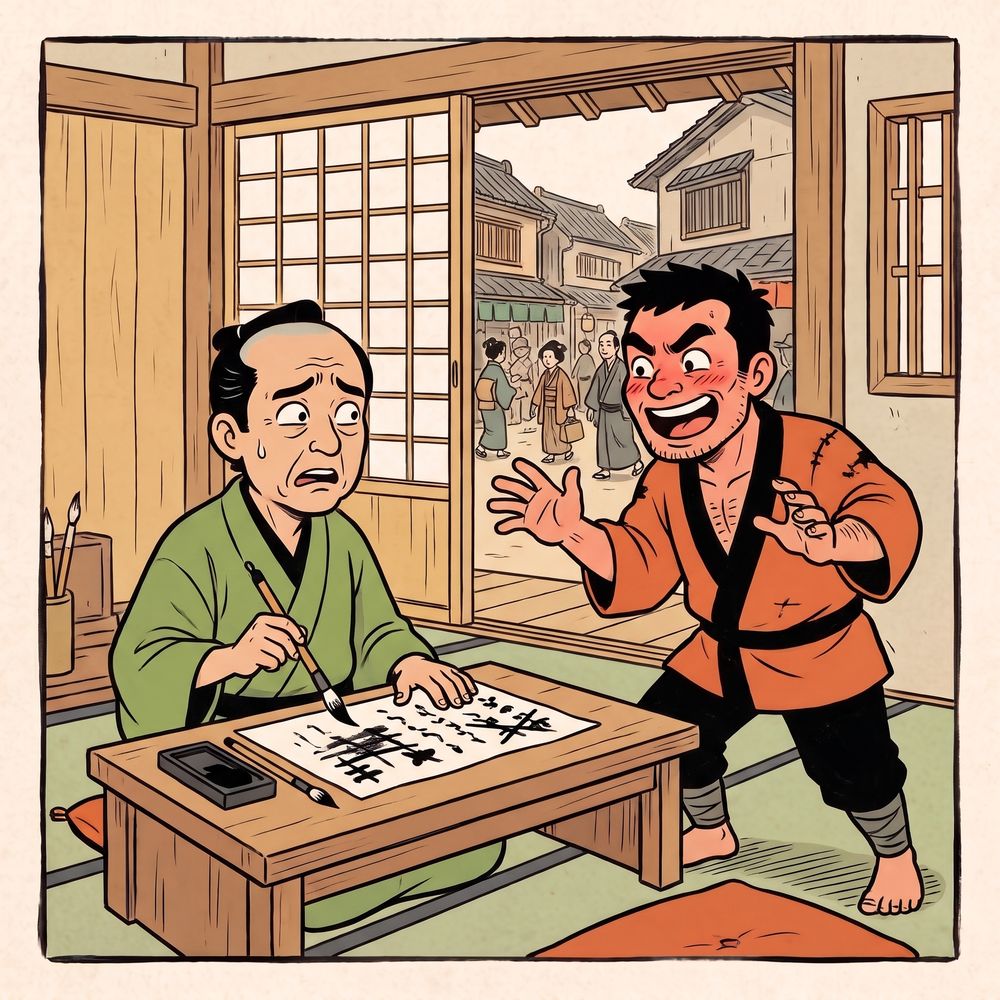
In Osaka in the Showa era, a man who can neither read nor write comes to a neighborhood daishoya (scrivener, someone who writes documents for others) to have his résumé written. His date of birth? “Don't know.” His work history? Nothing but businesses he quit as soon as he started them. Ask about honors and penalties, and he boasts about an eating contest. The scrivener's struggle, writing and crossing out and writing again, is what makes the audience laugh. The author is Katsura Yonedanji IV, who ran a scrivener's office himself. Today this Kamigata (Osaka-Kyoto style) story is widely performed in Tokyo as well.
The story
A man who can neither read nor write comes to a neighborhood scrivener and says, “I want you to write my résumé.” The scrivener holds up his folding fan as a brush and writes down what the man tells him.
But when asked for his registered domicile and his address, the man adds useless landmarks; for the characters of his name he says, “You decide”; and as for his date of birth, “I never had one.” The scrivener ends up having to work out the year he was born, counting backward from things that happened long ago that the man remembers.
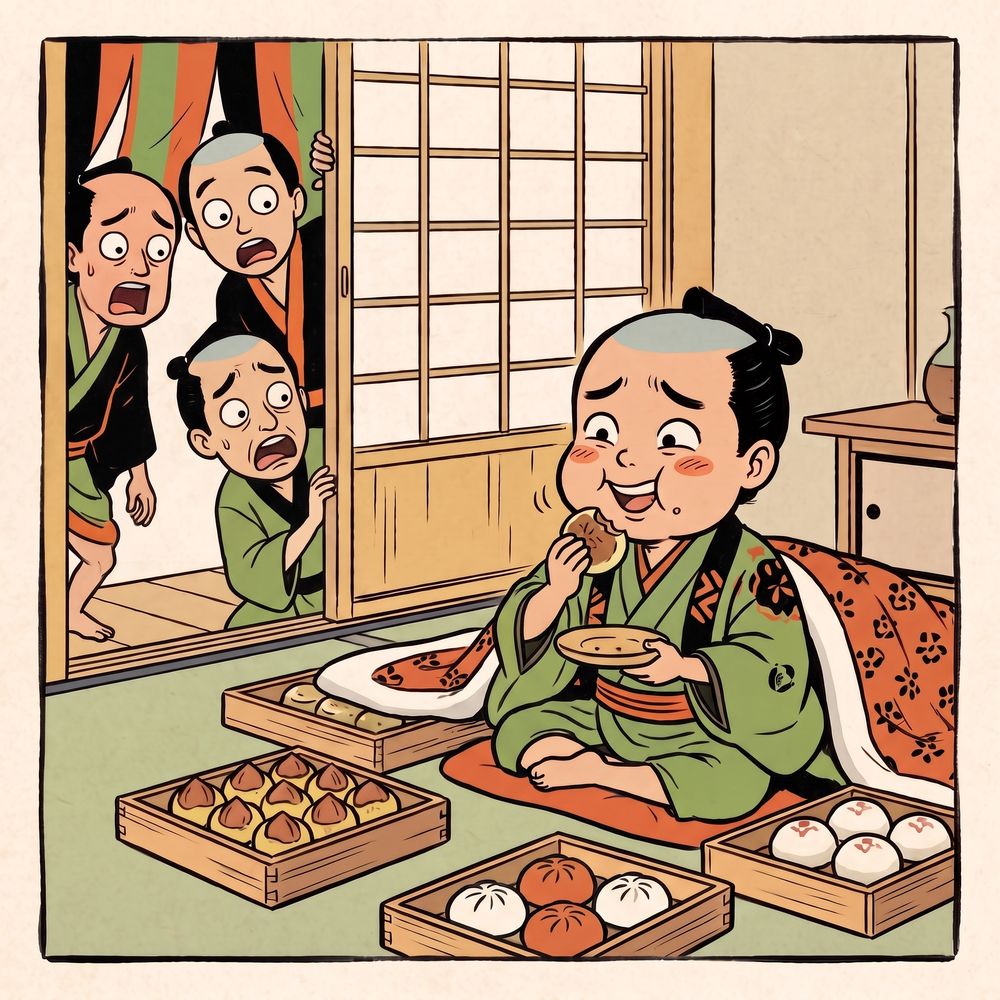
When asked about his work history, the man tells only stories of businesses he quit as soon as he started: he borrowed the tools from a friend to open a tomoe-yaki (also called imagawa-yaki, a filled griddle cake) stand but gave up because the rent was too high; he sold something to keep geta (wooden clogs) from wearing down at a night stall but quit after two hours because it was cold. Each time, the scrivener draws a line through the row he has just written. When asked about his real occupation, it turns out he is a gataro, who dredges river bottoms to pick up scrap iron. Somehow the scrivener manages to dress it up in words that look like they belong on a résumé.
In the section for honors and penalties, the man proudly announces, “I was in the newspaper,” but it turns out he was given an award at an eating contest. Today the story is usually cut around here.
When performed in full, there is a second half. An old man who says he cannot write because of palsy comes to ask for a receipt for betrothal gifts. After making endless demands about the brush and the ink, he looks at the lettering on the sign out front, remarks that it is “not very fine calligraphy,” and leaves.
Before long, a woman sent by the old man arrives with a generous writing fee as an apology for his rudeness. She asks the scrivener to write his name on the receipt, and when he hears that the old man is actually a famous calligrapher, the scrivener becomes so nervous that he can't write his own name. The woman writes the scrivener's name for him in beautiful characters, and beside it, in small characters, she adds...
The sage the punchline, contains spoilers
Tap to reveal the punchline
“Unable to sign; written on his behalf.”
These are the same words the scrivener wrote beside the man's name on the first résumé. The scrivener, whose trade is writing for other people, ends up having someone write for him. Today the story is rarely performed through the second half, and it is usually cut after the first half with the man. Katsura Beicho III said that “the real ending is the eating contest,” and Katsura Shijaku II changed the man's occupation to a pon-gashi (puffed rice snack) maker and ended the story with a big “Pon!” gesture.
The author's original and the versions of different performers
The story passed from its author, Katsura Yonedanji IV, to his disciple Katsura Beicho III, and it spread when Beicho taught it to Katsura Harudanji III and Katsura Shijaku II. Since it came to be cut after the first half, each performer has worked out his own changes to the man's name and the gags. In Tokyo it passed from Katsura Konan II to Yanagiya Kitahachi, and many storytellers perform it in the Edo form.
| Yonedanji IV's original | Katsura Beicho III | Katsura Shijaku II | |
|---|---|---|---|
| How much is performed | One customer after another: the first man, the old man who is particular about writing, a customer asking for a travel certificate, and the old man's messenger | Usually cut after the first man (he said “the real ending is the eating contest”). At the 1983 memorial performance he performed it in a form close to the original | |
| Name of the man who cannot write | Ota Tosuke | Tanaka Hikojiro | |
| The man's occupation and the ending | The sage is the signature on the receipt in the second half: “Unable to sign; written on his behalf” | Ends with the story of the award at an eating contest sponsored by a newspaper | |
| The date-of-birth scene | Originally the man answered, “I've never eaten one.” According to Shofukutei Shokaku VI, it became the current form, in which the man answers “I never had one,” at Shokaku's suggestion | — |
Key scenes original dialogue written for this site
Asking for his registered domicile
- ScrivenerFirst, your registered domicile. Tell me the address of the place where you were born.
- ManWhere I was born... My ma says it was the back room of the midwife's house.
- ScrivenerI don't need the room. Who puts a midwife's house down as their domicile?
- ManThen where I live now'll do. Two doors down from the udon shop on the corner.
- Scrivener...You needn't put the udon shop in either.
Asking for his work history
- ScrivenerAll right, tell me the businesses you've had so far, oldest first.
- ManFirst was tomoe-yaki. A friend said he had tools left over and I could use them.
- Scrivener(Running his fan-brush smoothly across the paper) “Engaged in the manufacture and sale of confectionery.” And how many years did you do that?
- ManWell, when I went to rent a spot, the rent was too high. I never baked any.
- (With the tip of his fan, he draws a long line through the row he has just written.)
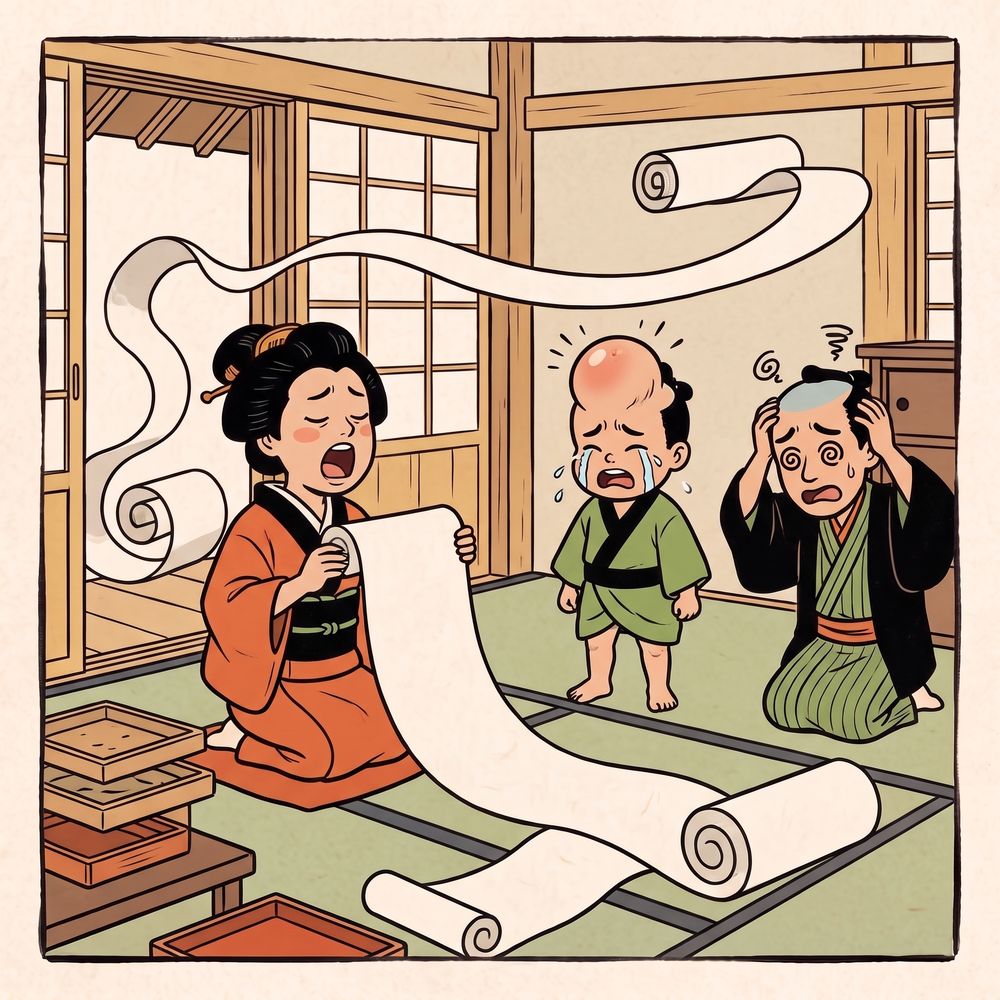
- ScrivenerIf you list businesses you never even did, I'll run out of paper.
Asking about honors and penalties
- ScrivenerHonors and penalties. Well, I don't suppose you've ever received an award.
- ManSure I have! I was in the newspaper, with a photo and everything.
- ScrivenerOh, that's something. Did you save somebody's life?
- ManI got an award at a botamochi (sweet rice cake) eating contest.
- Scrivener...And you think that goes on a résumé?
This is not a transcription of any storyteller's performance. The plot and the sage follow the classic version. All lines were written for this site.
Notable performers
- Katsura Yonedanji IV1896–1951KamigataThe author of this story. His own Daisho was his signature piece, and it is said that when he came on stage, the audience would call out, “Daishoya!” No recording of him performing this story has been confirmed.
- Katsura Beicho III1925–2015KamigataHe inherited the story from his teacher Yonedanji and passed it on to Katsura Harudanji III and Katsura Shijaku II. His performance at the 1983 memorial show for the 33rd-year memorial of Yonedanji's death was released on cassette tape.
- Katsura Harudanji III1930–2016KamigataHe asked Beicho to teach him the story before he took the name Harudanji. He kept a small repertoire, and this was one of its few stories.
- Katsura Shijaku II1939–1999KamigataOne of the best-known stories in his repertoire. He made bold changes, such as turning the man's occupation into a pon-gashi maker.
- Katsura Konan II1920–1996Kamigata and EdoA storyteller who performed Kamigata rakugo in Tokyo. He taught the story to Yanagiya Kitahachi, which led to its spread in Tokyo.
- Yanagiya Kitahachi1949–2016EdoHe brought this story, which he learned from Katsura Konan II, to the Rakugo Kyokai (Rakugo Association) and spread it there.