Sokotsu NagayaThe Scatterbrains of the Tenement
粗忽長屋(そこつながや)
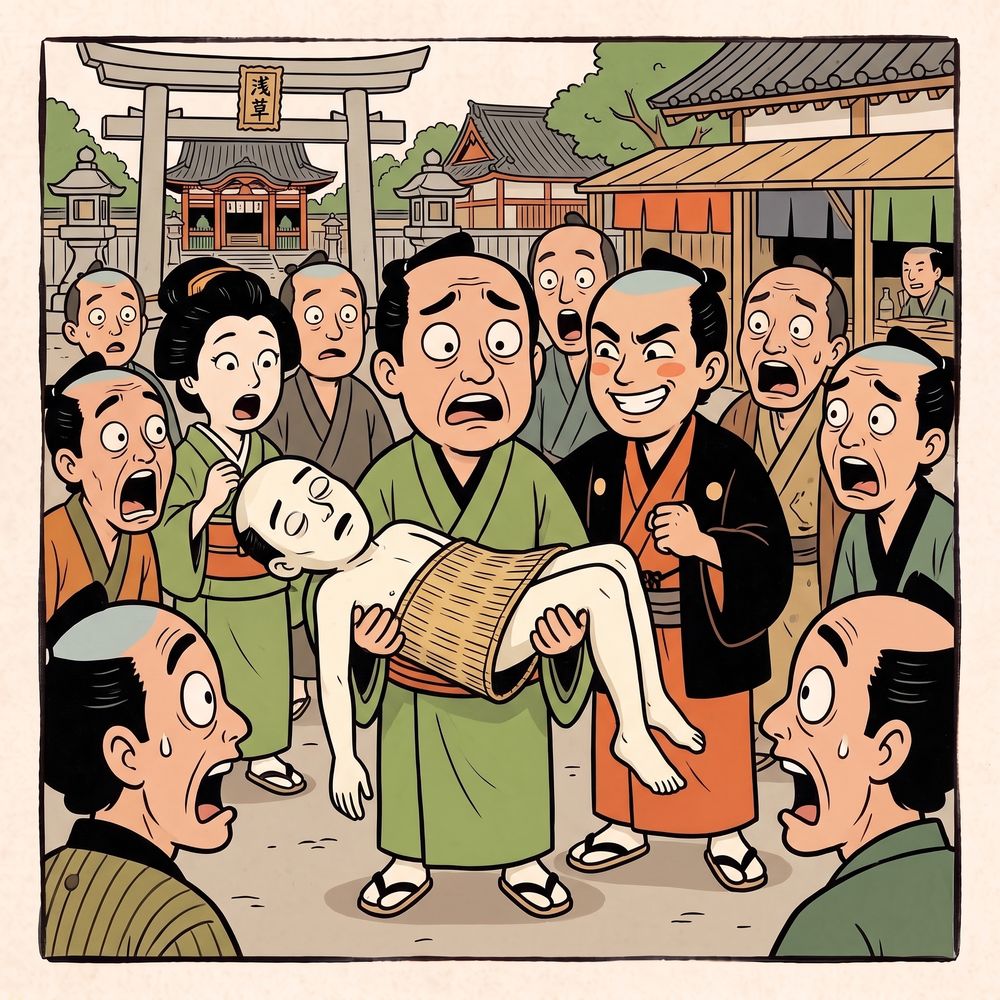
In Asakusa, Hachigoro sees a man who has died by the roadside and decides it's Kumagoro from his tenement. Told that he only saw Kumagoro this morning, he won't listen. He rushes home and tells Kumagoro himself, “You're dead!” As the two scatterbrains' assumptions pile up, the story heads somewhere truly absurd.
The story
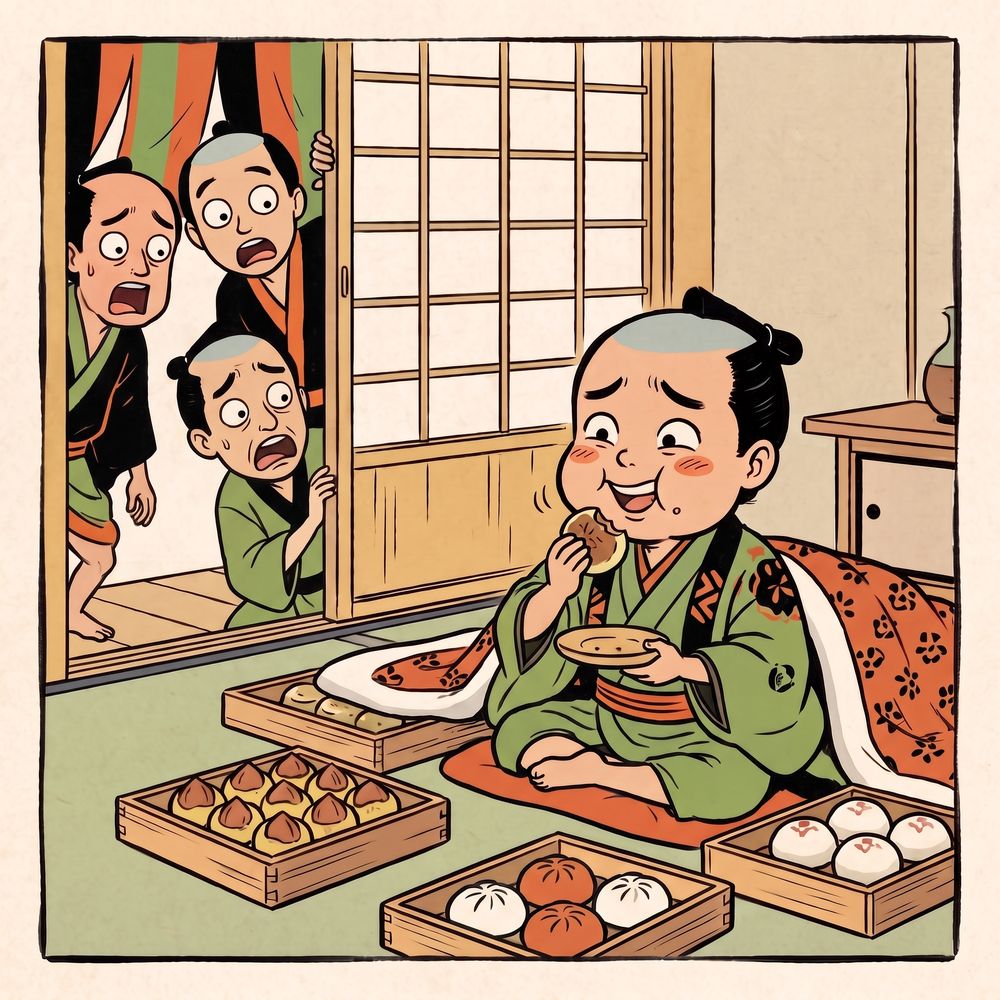
Hachigoro and Kumagoro live in the same nagaya (a row-house tenement), and both are hopeless scatterbrains. One day Hachigoro, visiting the Kannon temple in Asakusa, comes across a crowd. A man who collapsed and died by the roadside, identity unknown, has been laid out, and the onlookers are being shown his face in case anyone knows him.
Hachigoro takes a look and announces that it's Kumagoro from his tenement. But he saw Kumagoro just this morning. Told that the body has been lying here since last night, Hachigoro won't hear of it: “He's so scatterbrained, he died without noticing and went home.” He'll bring the man himself to claim the body, he says, and dashes back to the tenement.
“Kuma, you're lying dead in Asakusa!” At first Kumagoro laughs, but as Hachigoro rattles on at him, he starts to think it might be true. In the end the two of them set off together for Asakusa to collect Kumagoro's body.
Looking at the dead man's face, Kumagoro bursts into tears, miserable and heartbroken: yes, that's me, all right. Ignoring the onlookers who try to stop him, he lifts his own body in his arms. But the longer he studies its face, the more confused he becomes...
The sage the punchline, contains spoilers
Tap to reveal the punchline
“The one I'm holding is me, all right. But then who's the me that's holding him?”
This sage (the punchline) follows an impossible assumption to its end, where it runs straight into the question of who you really are. There's a philosophical flavor beneath the silliness, and it is sometimes discussed in connection with the problem of personal identity. Because the plot is so absurd, the story is said to demand real skill to carry the audience along without letting it feel forced. Yanagiya Kosan V said it was the hardest of all the stories about scatterbrains.
How performers portray the two
The plot is the same, but the feel of the story changes depending on how the performer shows the two men's convictions.
| Performer / lineage | Approach |
|---|---|
| The Yanagiya Kosan line | Draws Hachigoro and Kumagoro as a busy, diligent type and a lazy type, and shows their convictions deepening through ma (timing and pauses) |
| Kokontei Shincho III | Plays it as a runaway conviction no one can stop, moving it along with a fast tempo and a light rhythm |
| Tatekawa Danshi VII | Also called it “Shukan Nagaya” (The Subjective Tenement) and performed it as a story about how no one can stand up to a person with a strong enough sense of their own reality |
Key scenes original dialogue written for this site
The crowd
- HachigoroExcuse me, coming through... Hey! That's Kuma. That's Kumagoro from my tenement.
- OnlookerThis man's been lying here since last night. You said you saw this Kuma fellow this morning, didn't you?
- HachigoroSure I did. That's why I'm saying he was walking around without noticing he was dead.
At the tenement
- HachigoroKuma, stay calm and listen. You're lying dead in Asakusa.
- KumagoroQuit kidding around. I'm right here, fit as a fiddle.
- HachigoroDo you remember where you were and what you did last night?
- Kumagoro...Now that you mention it, I don't really remember.
Face to face
- (He peers into the dead man's face, falls silent for a while, then sniffles.)
- Kumagoro...Yeah, it's me. Dying all alone in a place like this. You poor thing.
This is not a transcription of any storyteller's performance. The plot and sage follow the classic version; the dialogue was written for this site.
Notable performers
- Yanagiya Kosan III1857–1930EdoTranscripts and recordings of his performances from the Meiji era survive, and the story became a signature piece of the Yanagiya school from then on.
- Yanagiya Kosan V1915–2002EdoLearned it directly from Kosan IV, and received the Arts Festival Encouragement Prize for it in 1962.
- Yanagiya Kosanji X1939–2021EdoConsidered a signature piece handed down from his master, Kosan V.
- Kokontei Shincho III1938–2001EdoKnown for a fast-paced staging different from the Kosan line.
- Tatekawa Danshi VII1936–2011EdoCalled it “Shukan Nagaya” (The Subjective Tenement) and performed it with his own interpretation.