Kogane-mochiGolden Rice Cakes
黄金餅(こがねもち)
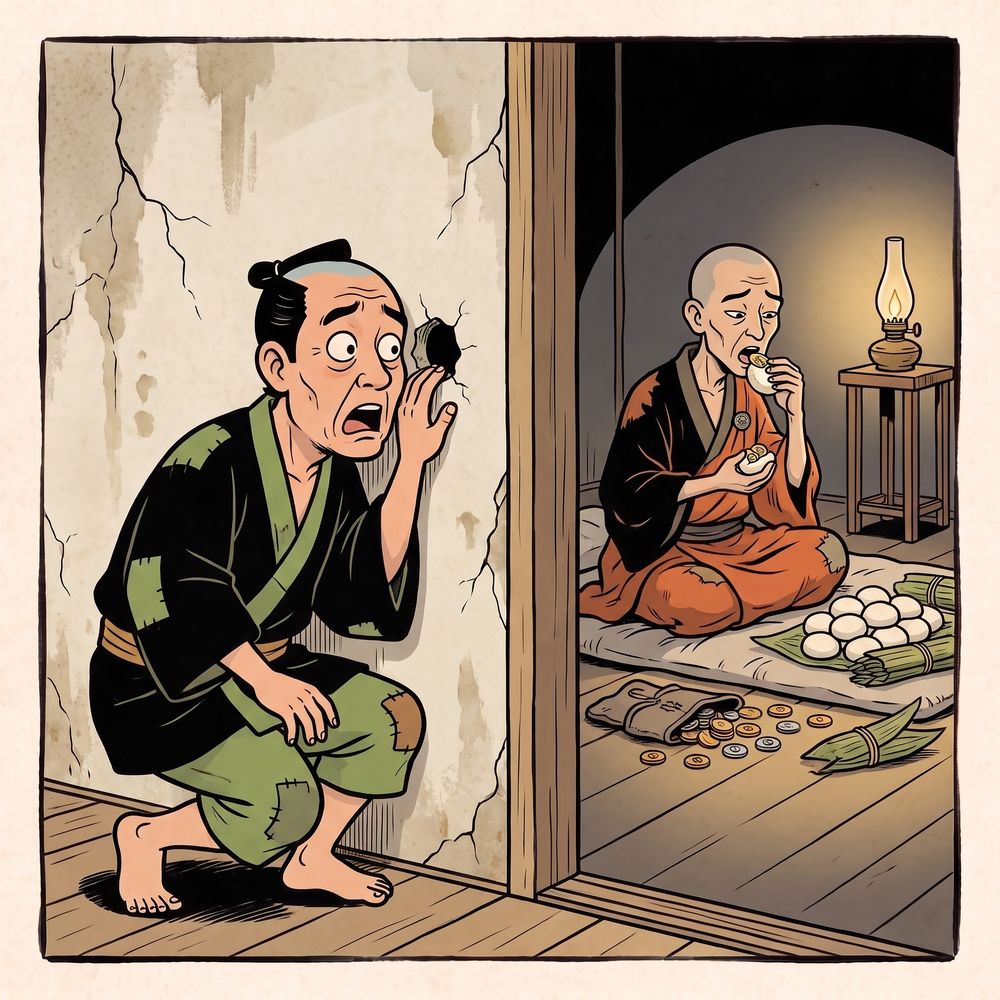
In a poor row house in Shitaya Yamazaki-cho, Sainen, a monk who lives by begging for alms, wraps the money he has hoarded in ankoro-mochi (rice cakes covered in sweet bean paste), swallows them one after another, and dies. His neighbor Kinbei, a seller of Kinzanji miso, has watched it all through a hole in the wall. To get the money in the dead man's belly, he leads the people of the row houses all the way to a temple in Azabu for the funeral. The highlight is the dochu-zuke, a recital of the streets of Edo from Shitaya to Azabu. The story is said to be by Sanyutei Encho I.
The story
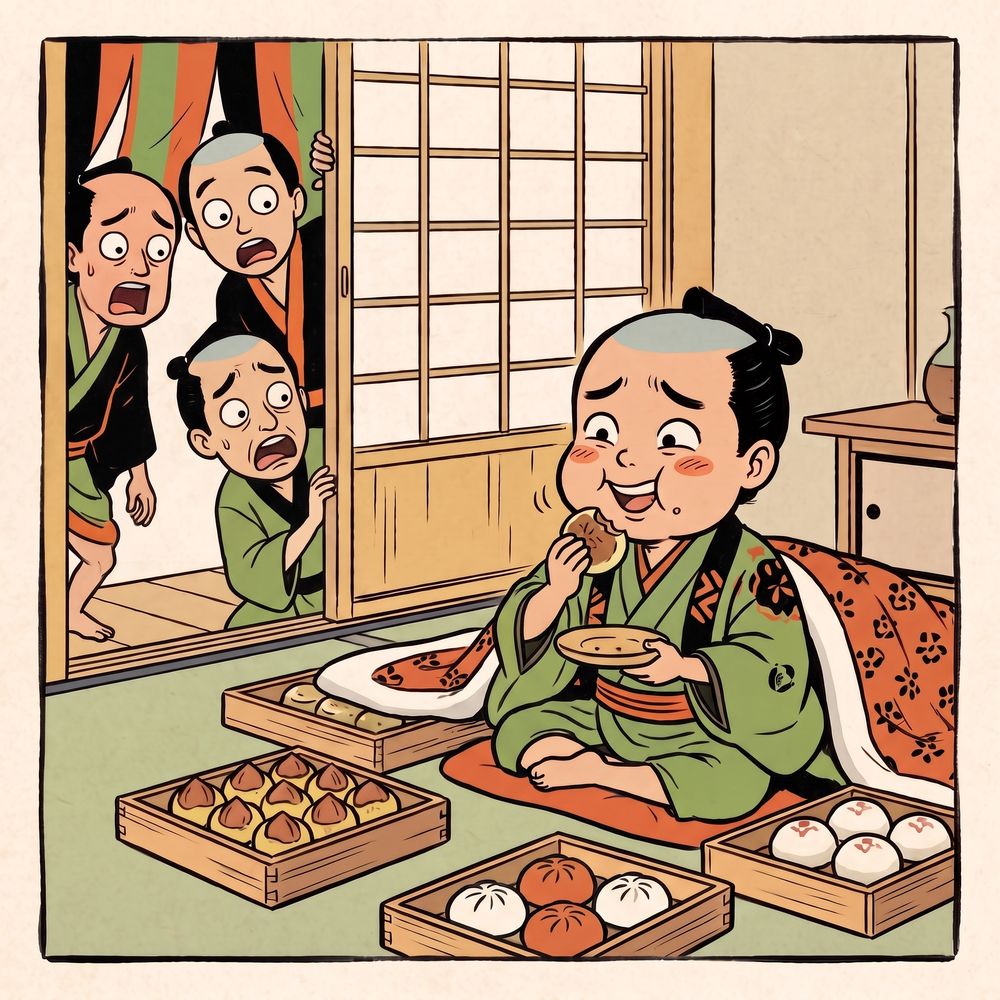
In a poor row house in Shitaya Yamazaki-cho lives Sainen, a monk who makes his living by begging for alms. Sainen, who has scrimped and saved every coin, falls ill when a cold gets worse. His neighbor Kinbei, a seller of Kinzanji miso, comes to see him and asks if there is anything he would like to eat. The answer is lots of ankoro-mochi (rice cakes covered in sweet bean paste). Kinbei spends what little money he has and buys a whole pile, but Sainen sends him away, saying, “It's my nature that I can't eat in front of other people.”
Finding this strange, Kinbei peeps through a hole in the wall. Sainen scrapes the bean paste off the rice cakes, pours out nibu gold coins and ichibu silver coins from the money belt around his stomach, wraps them one at a time in rice cake, and swallows them whole. When he has swallowed them all, he starts to choke. Kinbei rushes in and tries to make him spit them out, but Sainen keeps his mouth tightly shut and breathes his last.
Determined to make the money in Sainen's belly his own, Kinbei goes to the landlord and offers to hold the funeral at his own family temple, since Sainen has no relatives. Instead of a hayaoke (a round wooden coffin) they put him in a barrel, and so as not to keep anyone from work, they decide to do it that very night, and Kinbei and the people of the row houses carry him off along the dark streets. They are headed for Mokurenji temple in Azabu Zekko Kamanashi-mura (some sources write “Zekko” with different characters). Here the performer delivers the dochu-zuke, a long recital of the route from Shitaya to Azabu.
The priest of Mokurenji is drunk, and he has pawned even his kesa (a priest's robe) and his hossu (a ceremonial whisk). With a furoshiki (a wrapping cloth) in place of his robe, a duster in place of the whisk, and a teacup struck with chopsticks in place of the rin (a small bell), he chants a very dubious sutra. Meanwhile, Kinbei quietly takes a fish-cutting knife from the temple kitchen.
After sending the people of the row houses home, Kinbei goes alone to the crematorium at Kirigaya. He threatens the man there, who grumbles that he should wait until morning, into lighting the fire, and even gives the odd order to “leave the belly half-cooked.” When he comes back at dawn, he chases off the man who is about to gather the bones, probes with the knife, and at last finds the money. He stuffs it into his sleeves and walks off, leaving everything else as it is.
With this money as his capital, Kinbei opens a rice-cake shop in Meguro. It is a great success, and the shop's rice cakes come to be called “kogane-mochi,” golden rice cakes, and become a famous specialty of Edo. The story closes with this tale of how they got their name.
The sage the punchline, contains spoilers
Tap to reveal the punchline
(There is no sage; the story closes by telling how “kogane-mochi” got its name.)
This is known as a story without an ochi (a punchline). It ends by telling the origin of the shop: Kinbei got the money, opened a rice-cake shop, and it became the famous Edo specialty “kogane-mochi.” Incidentally, awa-mochi (millet rice cakes) sold as good-luck charms at temple and shrine festivals were also called “kogane-mochi,” but that name comes from the golden color of the cakes and has no direct connection with the plot of this story.
The dochu-zuke from the row houses to the temple
A dochu-zuke is a recital that lets the audience hear a journey by rhythmically listing the names of the towns, bridges and slopes along the way. In Kogane-mochi, the funeral party leaves Shitaya Yamazaki-cho and passes through Ueno, Kanda, Nihonbashi and Kyobashi, then via Atagoshita and Iikura to the temple in Azabu, all reeled off in one breath. The route and the wording differ a little from performer to performer. Below is the route given in “Minami-Azabu and Rakugo (Kogane-mochi),” a document from Minato City.
| Where they pass | Notes | |
|---|---|---|
| Departure | The row house in Shitaya Yamazaki-cho | Around present-day Higashi-Ueno and Kita-Ueno in Taito City |
| Ueno | From Yamashita at the foot of Ueno hill out to Ueno Hirokoji, then along the Onari Kaido road | ― |
| Kanda to Nihonbashi | Through the Sujikai Gomon gate at the crossing of the Kanda River, then from Kanda to Nihonbashi | ― |
| Kyobashi to Atagoshita | Straight on past Kyobashi, turning right before Shinbashi. Turning left at Atarashibashi bridge into Atagoshita | ― |
| Iikura to Azabu | Through Kamiyacho and up the slope at Iikura, then down Nagasaka slope from in front of “Okame Dango” in Iikura-katamachi. Out to Juban, up Daikokuzaka slope and on to Ipponmatsu | Okame Dango was a dango (dumpling) shop in Iikura-katamachi from the Edo period until the Meiji era |
| Arrival | Mokurenji temple in Azabu Zekko Kamanashi-mura (also written “Zekko” with different characters) | A fictional temple |
| Afterward | Kinbei carries the barrel alone on his back to the crematorium at Kirigaya | Present-day Nishi-Gotanda in Shinagawa City |
Key scenes original dialogue written for this site
Ankoro-mochi
- KinbeiSainen, isn't there anything you could get down? Don't be shy.
- SainenWell then... I'd like to eat lots of ankoro-mochi.
- KinbeiCan a sick man really eat that many? Well, never mind, I'll go buy you some.
- SainenThat's very kind of you. But it's my nature that I can't get food down in front of other people. Please, go on home.
The hole in the wall
- KinbeiCan't eat if someone's watching? What a strange thing to say. Let's see, through this hole...
- (He puts one eye to the hole in the wall. As he keeps watching, his eye grows rounder and rounder.)
- KinbeiHe's digging out the bean paste... Hey, that's money coming out of his money belt. He's wrapping it in rice cake and... he swallowed it. Look, he swallowed another one.
Mokurenji
- PriestA funeral, eh? Much obliged, but my kesa and my hossu have long since gone into the pawnbroker's storehouse.
- KinbeiCan't be helped. Hey, somebody lend him a furoshiki. And for the whisk, that duster over there will do.
- (He reverently waves a folded fan as if it were the duster, then mimes striking a teacup with chopsticks, ching.)
- Man from the row houses...That sutra just now was full of words I've never heard before.
This is not a transcription of any storyteller's performance. The plot follows the classic version. All lines were written for this site.
Notable performers
- Sanyutei Encho I1839–1900EdoSaid to be the author. In his stenographic record, the setting is a row house near Shogendonobashi bridge in Shiba, and the rice-cake shop is opened at the foot of Kanasugibashi bridge in Shiba.
- Kokontei Shinsho V1890–1973EdoCounted as one of his representative stories. At the 1958 Mitsukoshi Rakugo-kai he was due to perform this story as the tori (the closing act), but just before him “Wara Ningyo” (The Straw Doll), a story with a similar plot, was performed, so he changed his program.
- Kokontei Shincho III1938–2001EdoOne of the performers whose recordings survive.
- Tatekawa Danshi VII1936–2011EdoOne of the performers whose recordings survive.