AtagoyamaMount Atago
愛宕山(あたごやま)
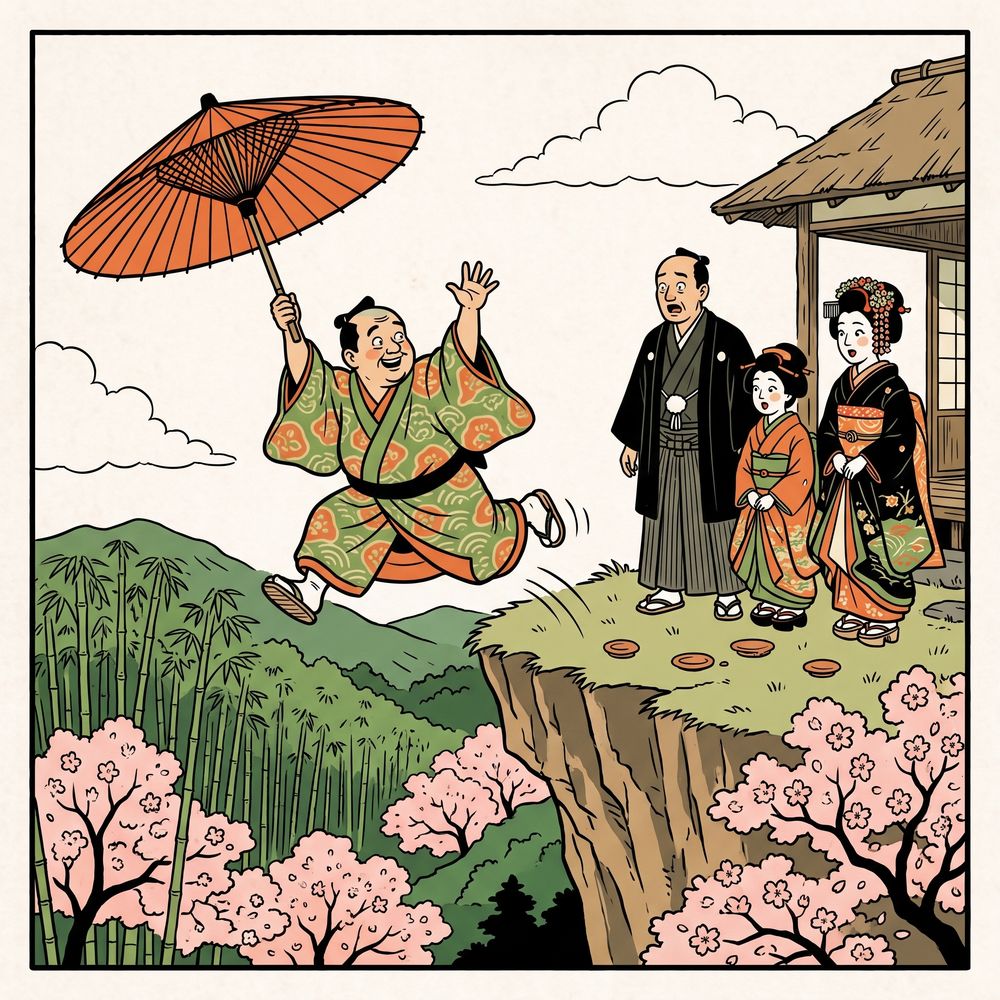
Ippachi and Shigehachi are taikomochi (professional jesters who entertain at parties) who got into trouble in Osaka and now work in Gion, Kyoto. One spring day they climb Mount Atago in attendance on their patron, together with geiko (geisha) and maiko (apprentice geisha). At the teahouse at the top, the patron enjoys kawarake-nage (throwing unglazed clay dishes) and in the end throws real koban gold coins into the valley. Told that whoever picks them up can keep them, Ippachi opens the teahouse's umbrella and jumps off the cliff... The spring mountain scenery and the taikomochi's desperate struggle are the highlights of this story.
The story
Ippachi and Shigehachi are taikomochi (professional jesters who entertain at parties) who got into trouble in the Minami district of Osaka and now work in Gion, Kyoto. One spring day their patron says, “The weather is fine, let's go for an outing in the countryside,” and the party, with geiko (geisha), maiko (apprentice geisha) and the proprietress of the ochaya (a teahouse where geiko entertain guests), sets off to the west.
Past Nijo Castle they come out into the fields, and at a maiko's request Ippachi chases butterflies, but they get away and he takes a bad fall. When he hears they are going to Mount Atago, the patron teases him: “There are no mountains in Osaka, so climbing must be hard for you.” Ippachi shoots back that Osaka has Sanadayama and Chausuyama, but the patron dismisses them as “boils on the ground.” Out of stubbornness Ippachi brags, “I'll skip right up a little hill like Mount Atago,” so he is made to carry everyone's luggage, and on the unfamiliar mountain path the two of them are soon completely worn out.
When they finally reach the teahouse at the top, there are kawarake, unglazed clay dishes, piled up at the front of the shop. They are for kawarake-nage, a game of throwing them from the top of the cliff at a target in the valley below. The patron is an old hand and lands one after another on the target, but when Ippachi tries the same, he cannot hit it at all. As a sore loser he says, “In Osaka we don't throw this sort of thing. We play by throwing gold and silver coins.” At that, the patron takes koban gold coins out of the front of his kimono and really does throw them into the valley.
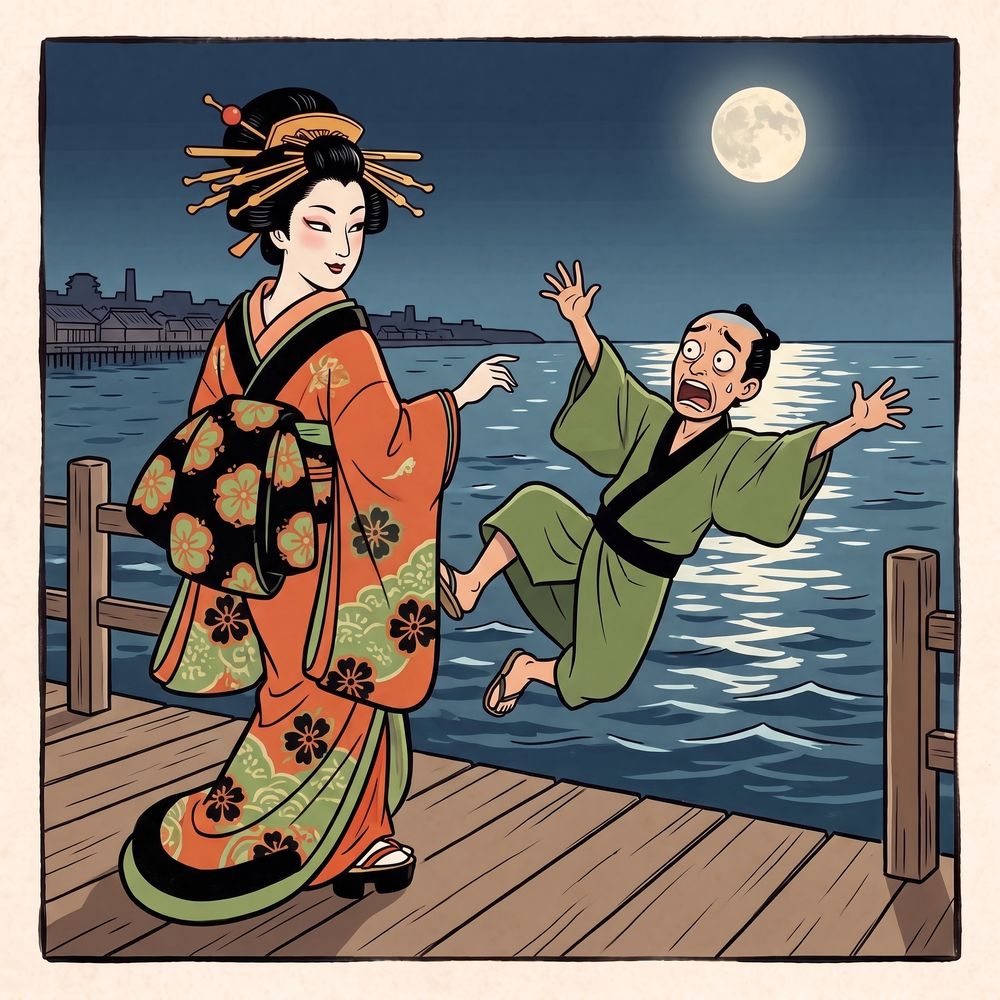
When Ippachi asks what will become of those coins, the patron answers, “Whatever is thrown belongs to whoever picks it up.” The old woman at the teahouse tells him the path down is long and dangerous, and Ippachi's eye falls on a large umbrella drying at the shop. If he opens it and jumps, he should float gently down to the valley floor. But when he stands at the edge of the cliff, his legs freeze and he cannot move. Unable to watch any longer, the patron whispers to Shigehachi, and with a push in the back from Shigehachi, Ippachi, clinging to the umbrella, lands in the valley.
Ippachi frantically gathers up the coins and is overjoyed when the patron tells him, “They're yours.” But then the patron asks, “So how are you going to get back up?” and Ippachi is stuck. He had thought only about getting down and had no plan at all for getting back up.
So Ippachi tears up the nagajuban (a long under-kimono) he is wearing, twists it into a rope, ties a stone to one end, and throws it to the top of a large bamboo growing on the slope of the valley, where it wraps around. He pulls on the bamboo with all his strength until it bends far over, gives one kick off the ground, and the spring of the bamboo carries him up the cliff in one go. When Ippachi makes it back to the patron and the others, the impressed patron praises him and asks about the coins...
The sage the punchline, contains spoilers
Tap to reveal the punchline
“Oh no, I left them behind!”
He risked his life to get down into the valley and used all his wits to get back up, but the coins themselves, the whole point, are still lying at the bottom of the valley.
Atagoyama in Kamigata and in Edo
This was originally a Kamigata story. Sanyutei Enba III learned it in Osaka and brought it to Tokyo, and Katsura Bunraku VIII was given it by Enba. In Kamigata, the scenes in the spring fields and the mountain climb are full of hamemono (musical accompaniment played during the story), and on the mountain path there is also a song that women at the teahouses along the approach to Mount Atago used to sing to call in customers.
| Kamigata | Edo | |
|---|---|---|
| The taikomochi | Osaka taikomochi who got into trouble in Minami, Osaka, and work in Gion, Kyoto | An Edo-born taikomochi. The patron also speaks the Edo dialect |
| Flavor of the story | Brings out the difference in temperament between a Kyoto patron and Osaka taikomochi, and the glamour of an evening at an ochaya | A version focused on Ippachi the taikomochi |
| Attachment to the coins | The taikomochi's attachment to money is drawn strongly | His attachment to money is drawn lightly, for a fresh, clean laugh |
| How it was handed down | There is a version passed from Bun-no-ya Kashiku (later Shofukutei Fukumatsu III) to Katsura Beicho III, and a version passed from Katsura Bunshi IV to Katsura Bunshi V | Brought to Tokyo by Sanyutei Enba III and taken up by Katsura Bunraku VIII |
Key scenes original dialogue written for this site
Osaka's mountains
- PatronIppachi, you were born in Osaka, so you've never climbed a mountain, have you?
- IppachiNot at all, sir. Osaka has Sanadayama and Chausuyama too.
- PatronThose? They're like boils that have come up on the ground.
- IppachiYou said it, sir. I'll run up a hill like Mount Atago humming a tune.
- PatronOh, how reassuring. Then you can carry everyone's luggage while you're at it.
The edge of the cliff
- IppachiAs long as the umbrella's open, I ought to float gently down... I ought to, but it's an awfully long way down.
- ShigehachiIppachi, aren't you ready yet? The sun will go down at this rate.
- IppachiDon't rush me. I'm saying a prayer to myself...
- (Shigehachi gently pushes him in the back. A folded fan stands in for the umbrella's handle, and he sinks down, clinging to it with both hands.)
The valley floor
- IppachiHere's one, here's one, and another one here. Sir, can I really keep these?
- PatronYes, they're yours. By the way, Ippachi, how are you planning to get back up?
- IppachiGet back up... Oh, I hadn't thought that far.
This is not a transcription of any storyteller's performance. The plot and the sage follow the classic version. All lines were written for this site.
Notable performers
- Sanyutei Enba III1882–1945EdoSaid to be the performer who learned this story in Osaka and brought it to Tokyo. He is also said to have performed a version in which he switched between a Tokyo patron, a geiko speaking Kyoto dialect and a taikomochi speaking Osaka dialect.
- Katsura Bunraku VIII1892–1971EdoHe was given this story by Enba. It is said that in his later years he kept performing it even after his doctor told him to stop because of its vigorous movements.
- Kokontei Shincho III1938–2001EdoOne of the performers whose recordings survive. His performance at the Rakugo Kenkyukai survives on video.
- Katsura Beicho III1925–2015KamigataHe performed the version he was taught by Bun-no-ya Kashiku (later Shofukutei Fukumatsu III).
- Katsura Bunshi V1930–2005KamigataHe performed the version he inherited from his teacher, Katsura Bunshi IV. Its butterfly-chasing part is short.