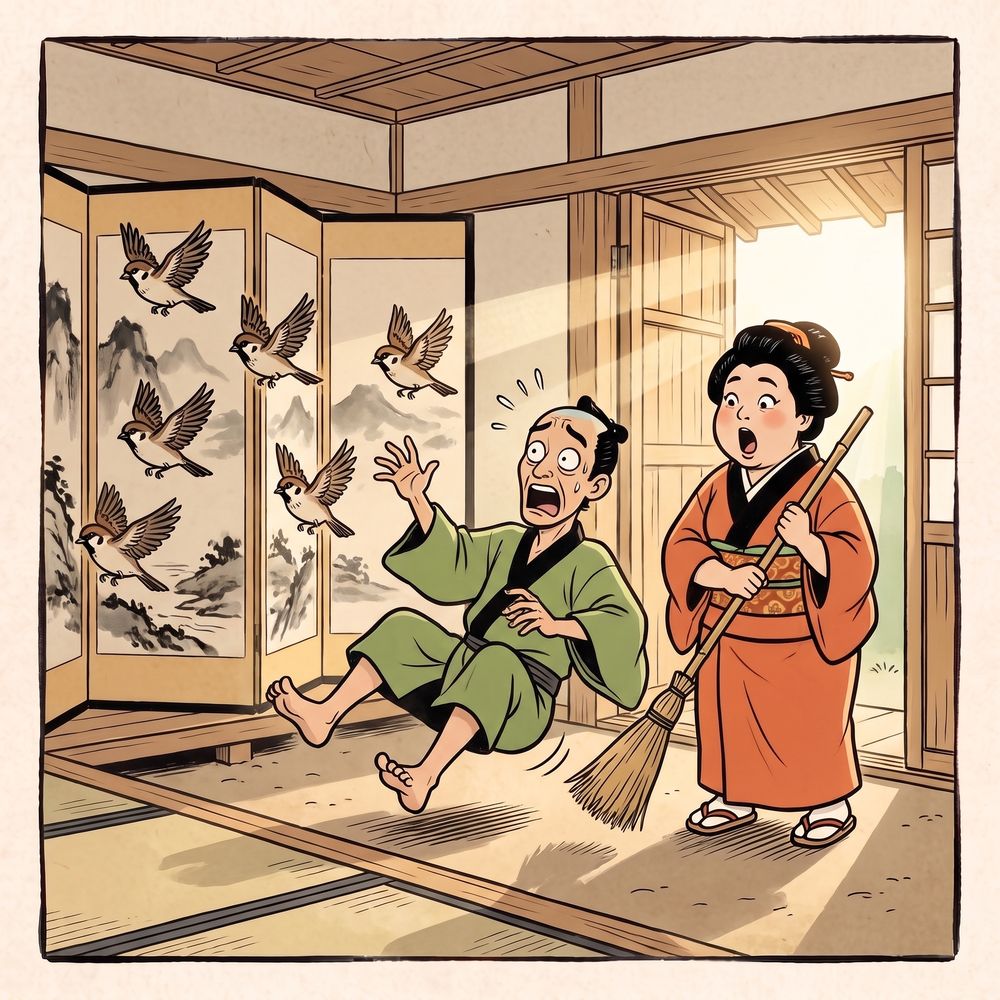
Nuke SuzumeThe Sparrows That Flew Out
抜け雀(ぬけすずめ)
A shabbily dressed young man stays at a small inn in the post town of Odawara. He drinks heavily every day and stays on and on, and when he's finally asked for payment, he hasn't a coin. Saying he's a painter and will leave a picture as security, he paints sparrows on the inn's folding screen and goes on his way...
The story
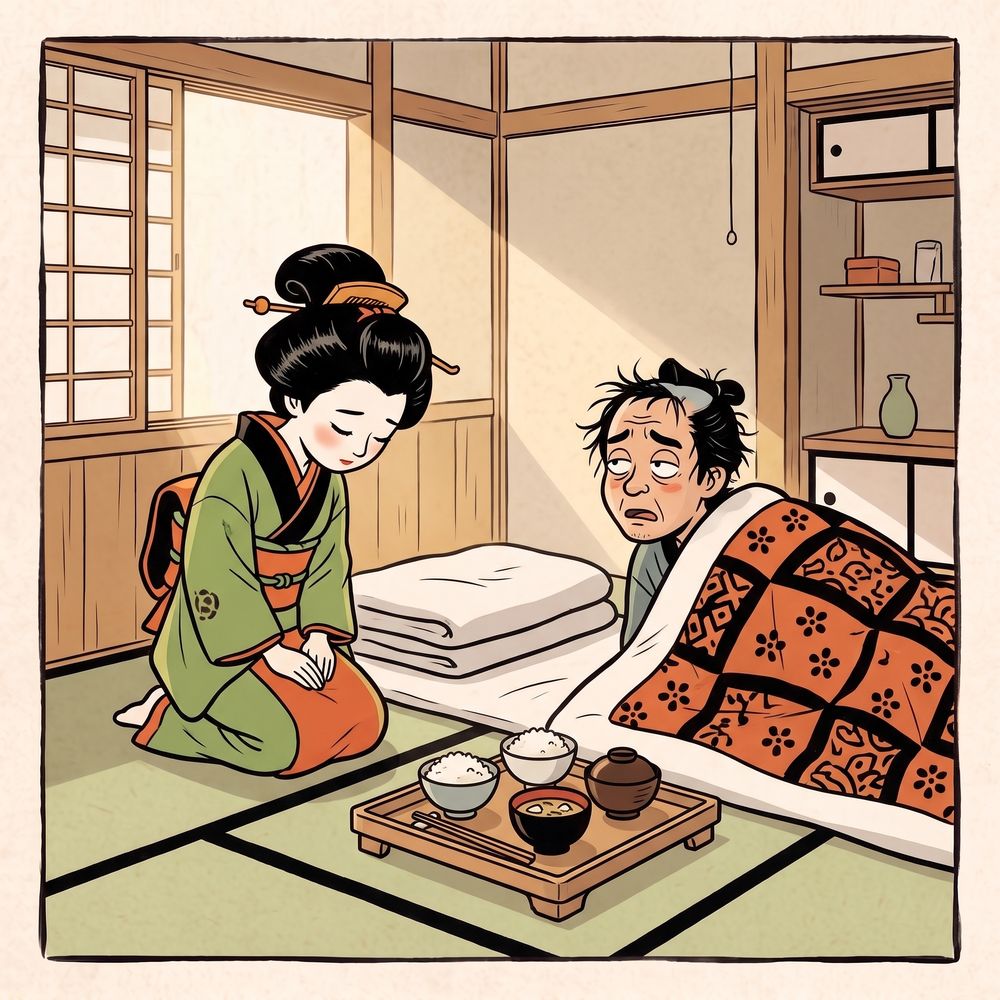
In the post town of Odawara, a good-natured man runs an inn that gets few customers. Nagged by his wife, he goes out to find guests and brings back a young man in shabby clothes. The man drinks morning, noon and night, and after seven days shows no sign of leaving. When the innkeeper timidly asks for a deposit, the man, as feared, doesn't have a coin.
The man says he is a painter, and as security for his bill, he paints five sparrows on the inn's plain white folding screen. “Don't sell this picture until I come back,” he says, and sets off on his travels.
The next morning, when the innkeeper opens the shutters, the sparrows, bathed in the morning sun, fly out of the screen, flutter around, and return to the picture. Word spreads, guests pour in, and the inn does a roaring trade. Eventually even the lord of Odawara asks to buy the screen.
One day a dignified old man stays at the inn. Looking at the screen, he says, “As it is, the sparrows will tire, fall and die.” He paints in a birdcage and a perch so they can rest, and from then on the sparrows rest there. Later the young painter returns, now finely dressed. When he sees the cage that has been added, he kneels before the screen with his hands on the floor and says, “I have been an undutiful son.” The innkeeper asks him why, and...
The sage the punchline, contains spoilers
Tap to reveal the punchline
“I made my own father a kago bearer.”
The old man who added the cage was the young painter's father. The sage (the punchline) is a pun: “kago wo kaku” means both “to paint a cage” (籠を描く) and “to carry a kago,” a palanquin (駕籠を舁く). By having his father “paint a cage,” the son has, in words, turned him into a palanquin bearer. Palanquin bearers were looked down on in those days, so this stands for failing in his duty as a son.
The Words of the Sage
The sage stacks up words that sound the same. Because these words are unfamiliar today, some performers explain palanquin bearers in the makura (the opening talk) beforehand.
| Word | Meaning |
|---|---|
| Kago wo kaku (painting a cage) | The father painting a birdcage onto the screen |
| Kago wo kaku (carrying a palanquin) | Carrying a palanquin. Kago bearers were laborers who carried travelers along the highways |
| Tsuitate (folding screen) | A piece of furniture used to divide a room or block the view. Inns placed them at the entrance |
| Tomarigi (perch) | The crossbar a bird sits on inside a cage, painted in so the sparrows could rest |
Key scenes original dialogue written for this site
Asking for the Bill
- InnkeeperUm, sir. I'm terribly sorry to bring this up, but if you could perhaps pay a little something in advance...
- PainterCan't.
- Innkeeper...Can't, sir?
- PainterI haven't got a coin. But I am a painter. Lend me that screen over there.
The Sparrows Fly Out
- (The innkeeper opens the shutters one by one, squints in the morning sun, and happens to glance at the screen.)
- InnkeeperHey, dear, come look! The sparrows... the painted sparrows are flying!
- WifeTalking nonsense first thing in the morning... Oh my goodness, it's true!
The Old Man's Addition
- Old manSplendid work, but it's a pity: these sparrows have nowhere to rest. Sooner or later they'll tire and fall.
- InnkeeperOh, is that how it works, sir?
- Old manLend me a brush and an inkstone. I'll paint them a cage and a perch.
This is not a transcription of any storyteller's performance. The plot and the sage are as handed down in the classical tradition; the dialogue was written for this site.
Notable performers
- Kokontei Shinsho V1890–1973EdoRevived this story and made it a signature piece of the Kokontei family.
- Kingentei Basho X1928–1982EdoShinsho's eldest son, who carried it on as a family piece.
- Kokontei Shincho III1938–2001EdoShinsho's second son, who carried it on as a family piece.
- Katsura Beicho III1925–2015KamigataOne of the performers who took it up in kamigata.