Botan DoroThe Peony Lantern
牡丹灯籠(ぼたんどうろう)
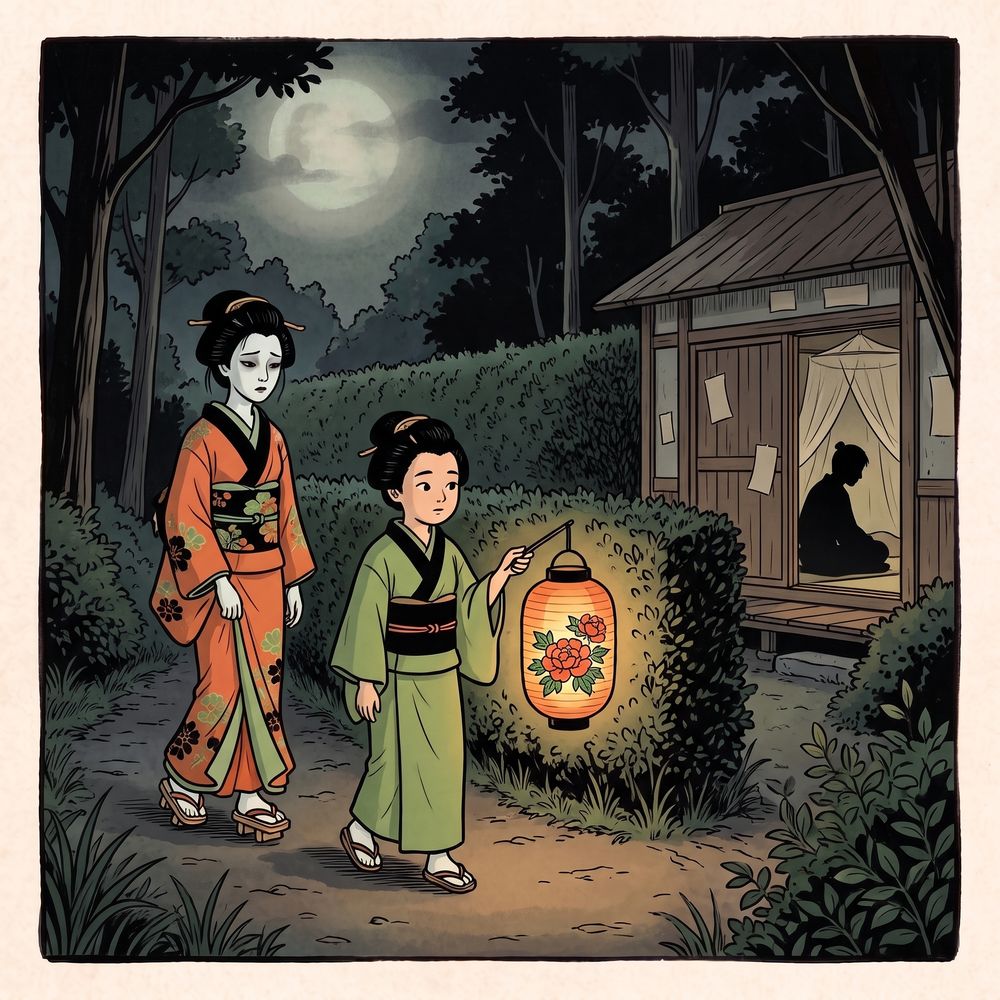
Hagiwara Shinzaburo is a ronin (a masterless samurai) living in Shimizudani, Nezu. From the night of Obon, Otsuyu, the daughter of a hatamoto (a direct retainer of the shogun), comes to visit him, with her maid Oyone carrying a lantern decorated with peony flowers. But Otsuyu is supposed to have died of longing for Shinzaburo. Shinzaburo seals his house with paper charms, but then Tomozo, one of his tenants, and his wife Omine receive a request from the ghosts: please peel off the charms... This is a long kaidan-banashi (ghost story) by Sanyutei Encho I.
The story From “Otsuyu and Shinzaburo” to “Ofuda-hagashi”
Hagiwara Shinzaburo is a ronin who owns fields and rental tenements in Shimizudani, Nezu, and lives on the income. The doctor Yamamoto Shijo takes him on an outing, and there he meets Otsuyu, the daughter of the hatamoto Iijima Heizaemon. The two fall for each other at first sight, but they never meet again, and time passes. Eventually Shijo tells him that Otsuyu has died of longing for him, and that her maid Oyone soon died as well.
The thirteenth night of Obon. As Shinzaburo gazes at the moon, he hears wooden clogs going karan-koron, and along come Oyone, carrying a lantern decorated with peony flowers, and Otsuyu, who is supposed to be dead. Each had been told that the other was dead, and they rejoice. From that night on, Otsuyu comes to Shinzaburo almost every night.
Tomozo, one of Shinzaburo's tenants, peeks through a gap in the door late at night. Clinging to Shinzaburo's neck is a woman who is nothing but skin and bones. Hakuodo Yusai, a physiognomist who hears about this from Tomozo, sees the shadow of death on Shinzaburo's face. Shinzaburo goes around Sansaki-mura in Yanaka, where the women said they lived, and on his way back he passes through the Shin-Banzuiin temple, where he finds a new grave and a peony lantern he recognizes.
Ryoseki, the priest of Shin-Banzuiin, lends him a solid gold statue of the Kaion Nyorai (a Buddha) as protection against the dead, and gives him paper charms. Shinzaburo pastes the charms on the doors and windows and shuts himself in. Otsuyu and Oyone cannot get in, and can only circle the house, lamenting.
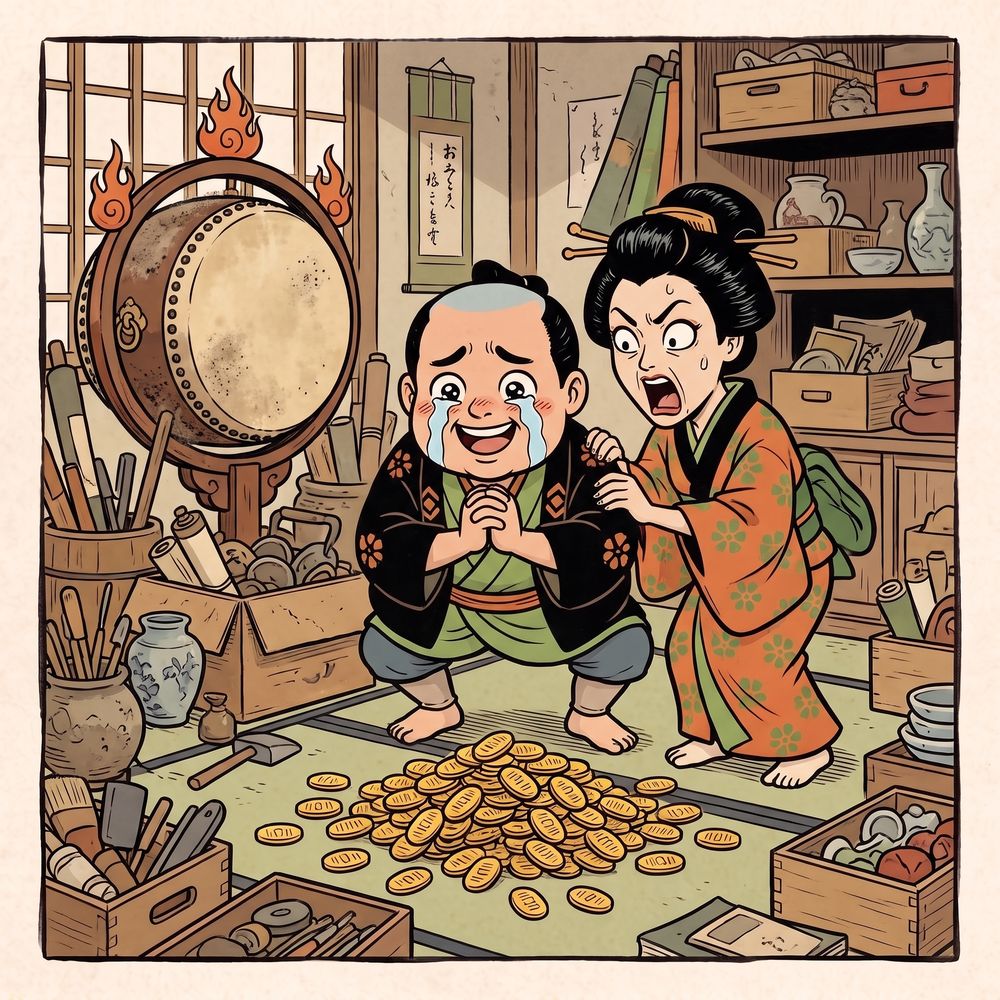
At a loss, Oyone brings Otsuyu to Tomozo and asks him to peel off the charms and take away Shinzaburo's protective Buddha. Tomozo is terrified to learn they are ghosts, but his wife Omine has an idea: if anything happens to their landlord they will have nothing to live on, so he should do it in exchange for a hundred ryo.
Tomozo and Omine urge Shinzaburo to take a bath in a tub, and while Omine is washing him, Tomozo swaps the Kaion Nyorai that Shinzaburo keeps on him for a clay statue of Fudo that he has brought along. That night, when Oyone appears with the hundred ryo, Tomozo climbs a ladder on shaking legs and peels off the charm on the back window. The next morning Shinzaburo is found dead, his face twisted in agony, and beside him lies a skull, clinging to his neck. The story then goes on to what happens to Tomozo and Omine after they get their hands on the hundred ryo.
The sage the punchline, contains spoilers
Tap to reveal the punchline
(As a serial, it has no set sage)
In Encho's sokkibon the story runs to twenty-odd chapters. It was originally a serial told over many nights. At yose and rakugo shows, performers tell only one part, and instead of ending on a set sage (a punchline) such as a jiguchi (a pun), they end at a break in the story.
How the long story fits together, and its main parts
The whole work weaves together two plots that move forward in turns: a ghost story about Otsuyu, Shinzaburo, and Tomozo and his wife, and a revenge story about Iijima Heizaemon and his servant Kosuke. The well-known story of Shinzaburo haunted by Otsuyu's ghost is only part of the first half of the long work.
| What happens | Plot | |
|---|---|---|
| Beginning (The Sword Shop) | The young Iijima Heizaemon (then called Heitaro) cuts down Kurokawa Kozo, a samurai who is a violent drunk, in front of a sword shop | Revenge plot |
| Otsuyu and Shinzaburo | Introduced by Yamamoto Shijo, Otsuyu and Shinzaburo meet and fall for each other at first sight | Ghost plot |
| Ofuda-hagashi (Peeling Off the Charms) | In exchange for a hundred ryo, Tomozo and his wife take away Shinzaburo's protective Buddha and charms | Ghost plot |
| Kosuke's Spear | Kosuke, a servant of the Iijima household, mistakes his master Heizaemon for the adulterer Genjiro and stabs him | Revenge plot |
| Kurihashi (The Murder of Omine) | Tomozo, who has used the hundred ryo to open a general store (the Sekiguchiya) in Kurihashi, kills his wife Omine | Ghost plot |
| Sekiguchiya | Omine possesses the shop's servants and blurts out Tomozo's crimes, and things start to move when Tomozo meets Shijo again | Ghost plot |
| Ending | Tomozo is arrested, and Kosuke takes revenge on Okuni and Genjiro, his master's enemies | The two plots meet |
Key scenes original dialogue written for this site
The night of Obon
- (From far away, the karan-koron of wooden clogs comes closer)
- ShinzaburoWho's there so late at night? ...Why, that lantern...
- OyoneOh my, Master Hagiwara. Miss, it's Master Hagiwara.
- ShinzaburoI was told that Otsuyu had passed away...
- OtsuyuAnd I was told that it was you who had passed away.
A request through the mosquito net
- OyoneTomozo, I have a favor to ask. Please, peel off the charms on Master Hagiwara's house.
- TomozoN-no way. If I did that, who knows what would happen to the master...
- OyoneUnless you peel them off, my mistress will go on weeping every night.
- TomozoW-wait till tomorrow night. I've got to talk it over with the wife.
The couple talks it over
- TomozoSay no and they'll curse us. Peel 'em off and the master's in danger. Either way it's bad news.
- OmineListen, if the master's gone, we won't have anything to eat either.
- TomozoThat's exactly why I'm stuck.
- OmineThen take the job, but get money for it. Tell them a hundred ryo. With that much, we could even open a little shop.
This is not a transcription of any storyteller's performance. The plot follows the classic version; the dialogue was written for this site.
Notable performers
- Sanyutei Encho I1839–1900EdoThe author of this story. He took a Chinese ghost story and built it into a long work full of revenge and murder. The sokkibon was published in 1884.
- Sanyutei Ensho VI1900–1979EdoOne of the performers known for this story.
- Kokontei Shinsho V1890–1973EdoOne of the performers known for this story.
- Hayashiya Shozo VIII (Hayashiya Hikoroku)1895–1982EdoOne of the performers known for this story.