Hatsu TenjinThe First Tenjin Festival of the Year
初天神(はつてんじん)
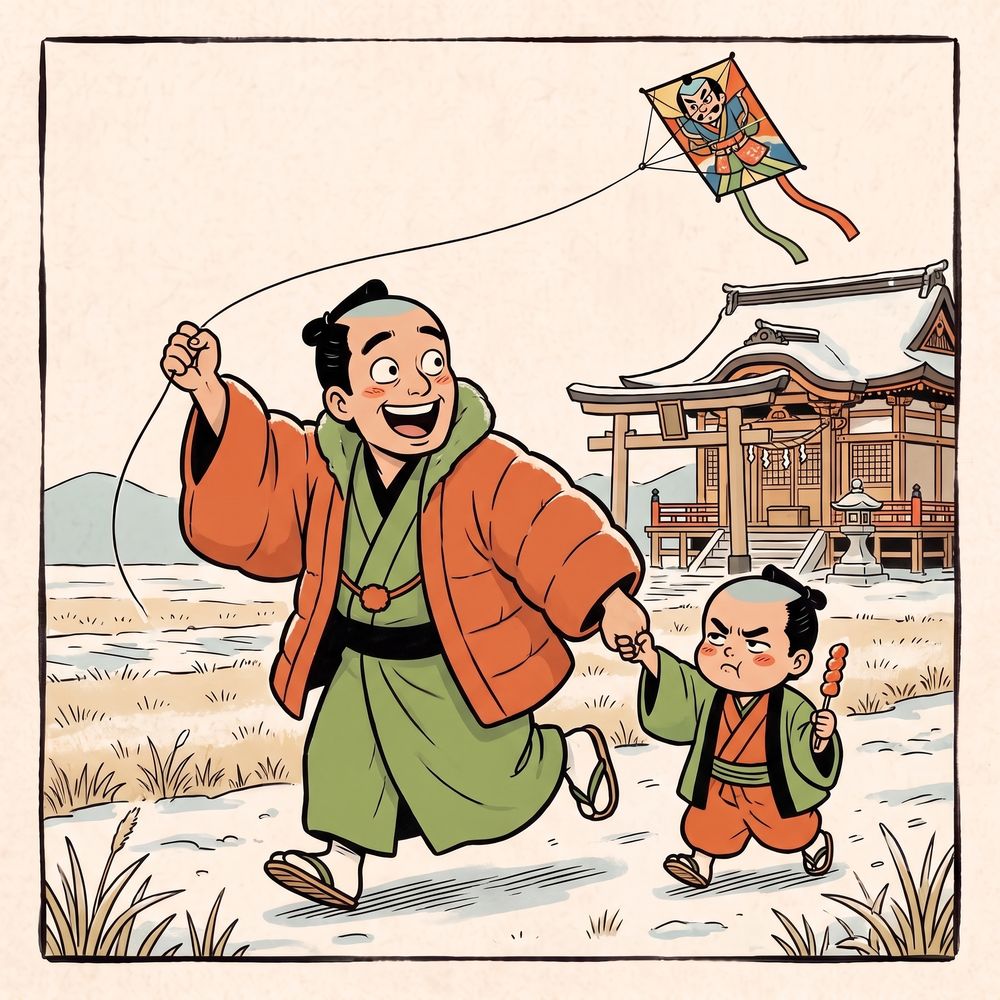
January 25 is Hatsu Tenjin, the first Tenjin festival of the year. A father who wants to go alone is told by his wife to take their son, so he grudgingly does. The promise not to buy anything soon falls apart: first candy, then a kite. And once the kite is up in the air, the one who can’t let go is the father.
The story
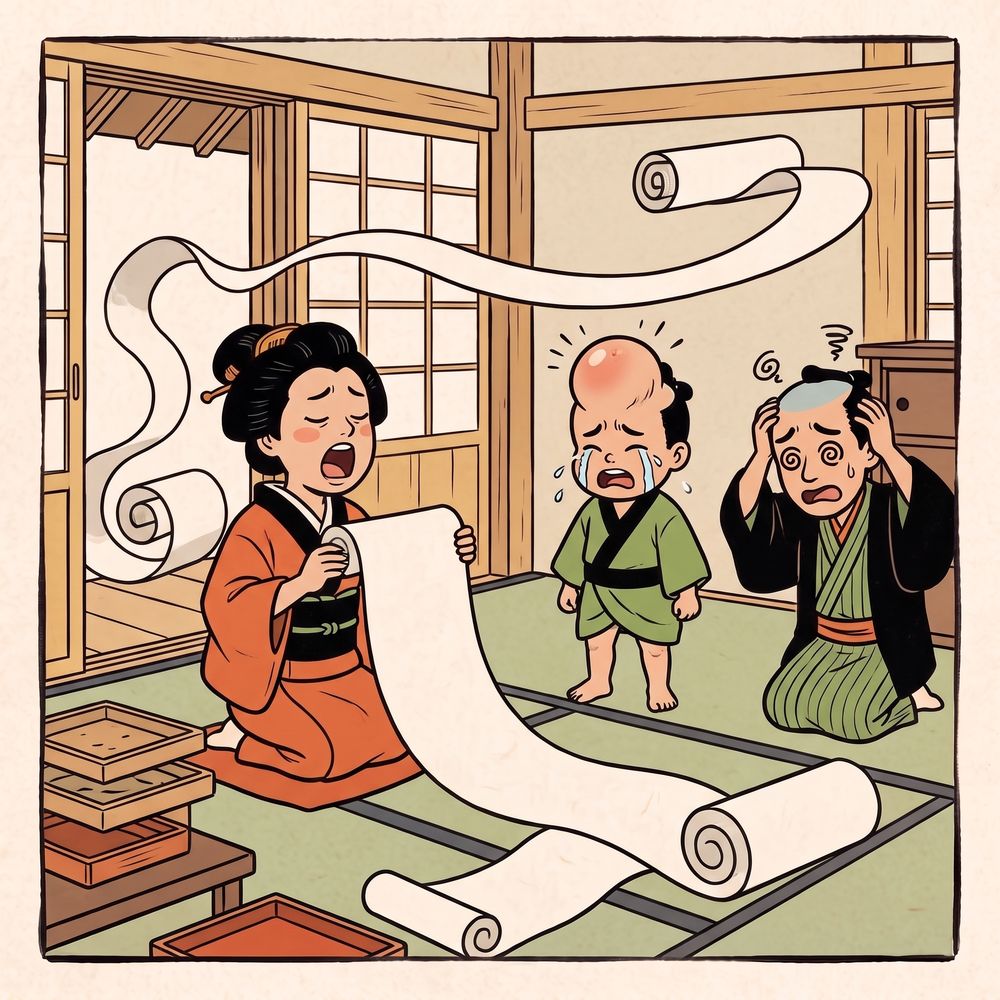
It is January 25, Hatsu Tenjin. A man about to set off alone for the Tenjin shrine is told by his wife to take their son along. He refuses, knowing the boy will beg for one thing after another at the stalls. But when the son threatens to tell the neighbors their family secrets if he’s left behind, the father makes him promise not to ask for anything and takes him along.
So much for the promise: the son tries every trick to get something bought for him. Worn down, the father buys him a piece of candy, figuring a full mouth will keep him quiet. In the Tokyo version, a whole commotion over a skewer of dango (rice dumplings) is sometimes added here.
On the way back from praying, the son begs for a kite in front of the kite stall, and the kite seller cleverly eggs him on. Having been talked into buying a kite, the two head to an empty lot next to the shrine. The father, who was good at flying kites as a boy, takes the string to show him how it’s done.
But once the kite is up, the father is completely hooked. No matter how many times the son asks for a turn, he brushes him off. Finally the son gives up and...
The sage the punchline, contains spoilers
Tap to reveal the punchline
“I wish I’d never brought Dad along.”
This is the sage (the punchline) in the Kamigata version. The father was supposed to be bringing his son, but now the son regrets bringing his father, and that reversal of roles is the joke. In the original tale “Tako,” it is the father who grumbles at the end that he shouldn’t have brought the boy, and it is sometimes performed that way in Kamigata as well. In Tokyo, a well-known ending has the son bump into someone while flying the kite, and the father apologizes; then, when the father bumps into someone, the son apologizes: “Please forgive him. He’s only a grown-up.”
The Kamigata and Tokyo Endings
Originally a Kamigata story, it was brought to Tokyo by Sanyutei Enba III. In both versions, the climax is the kite flying, where father and son trade places, but the endings differ.
| Kamigata | Tokyo | |
|---|---|---|
| Sage | The son grumbles, “I wish I’d never brought Dad along” | When the father bumps into someone, the son apologizes for him: “Please forgive him. He’s only a grown-up” |
| How it spread | A Kamigata story from the start | Brought from Kamigata by Sanyutei Enba III |
| Difference from the original tale | In the original “Tako,” the father is the one who grumbles. In rakugo, giving the line to the child became the main version | |
Key scenes original dialogue written for this site
Take him with you
- WifeIf you’re going to the Tenjin shrine, take the boy with you.
- FatherNo way. It’s “buy me this, buy me that” the whole time.
- SonIf you don’t take me, I’ll tell the lady next door what you said last night.
- Father...All right, all right. But you don’t ask for anything. Got it?
Just one candy
- SonI won’t ask. I won’t ask, but that candy sure looks good.
- FatherThat’s what asking is.
- SonI’ll be really good. Think of it as paying my reward in advance.
- (He reluctantly pulls coins from inside his kimono, lips pursed in a pout.)
Flying the kite
- FatherWatch this. You catch the wind like so... There it goes, up, up!
- SonDad, let me have a turn now.
- FatherQuiet, this is the good part.
- (Eyes fixed on the sky, he becomes absorbed in reeling the string in and out.)
This is not a transcription of any storyteller's performance. The plot and the sage follow the classic version. The dialogue was written for this site.
Notable performers
- Sanyutei Enba III1882–1945EdoA native of Osaka, he is said to have brought this story to Tokyo.
- Yanagiya Kosanji X1939–2021EdoOne of his main signature pieces.
- Yanagiya Sankyo1948–EdoKnown as one of his signature pieces.
- Shunputei Ichinosuke1978–EdoOne of his signature pieces. He also performs Dangoya Seidan, a reworking that expands the dango scene.