TensaiAct of Heaven
天災(てんさい)
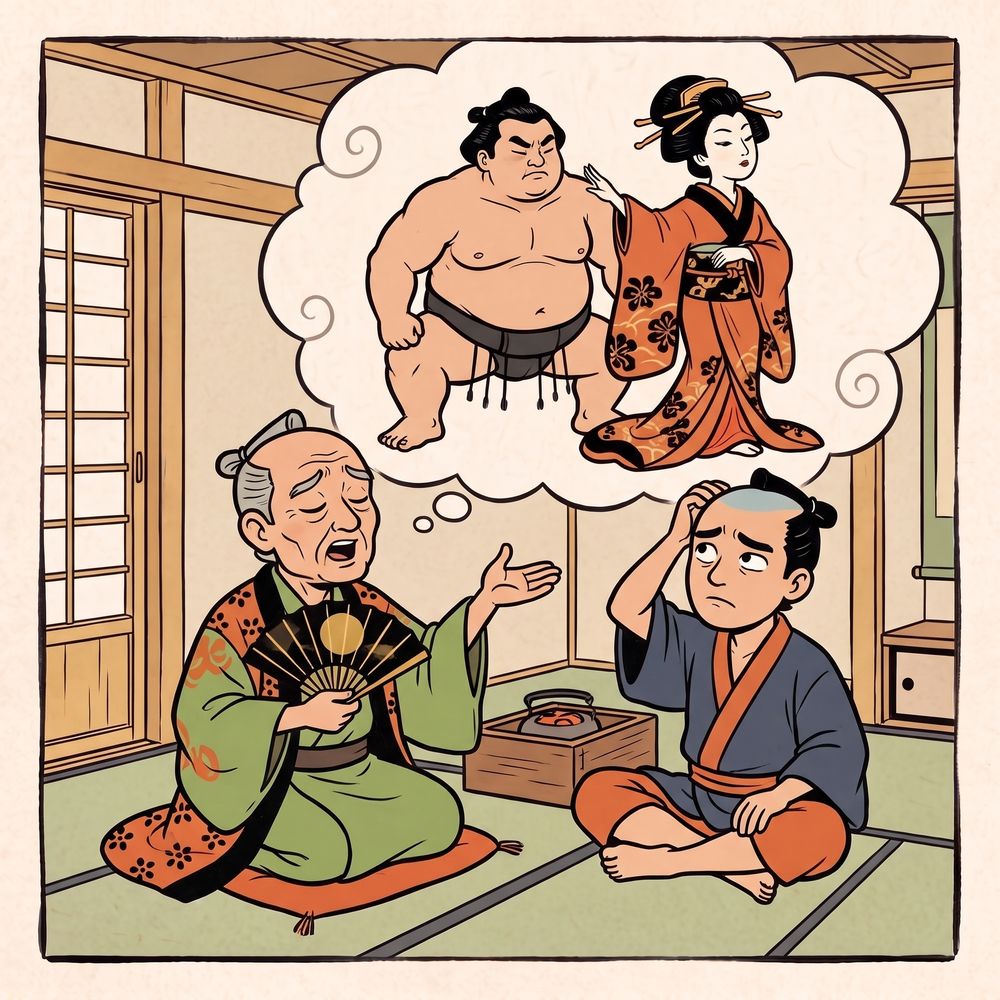
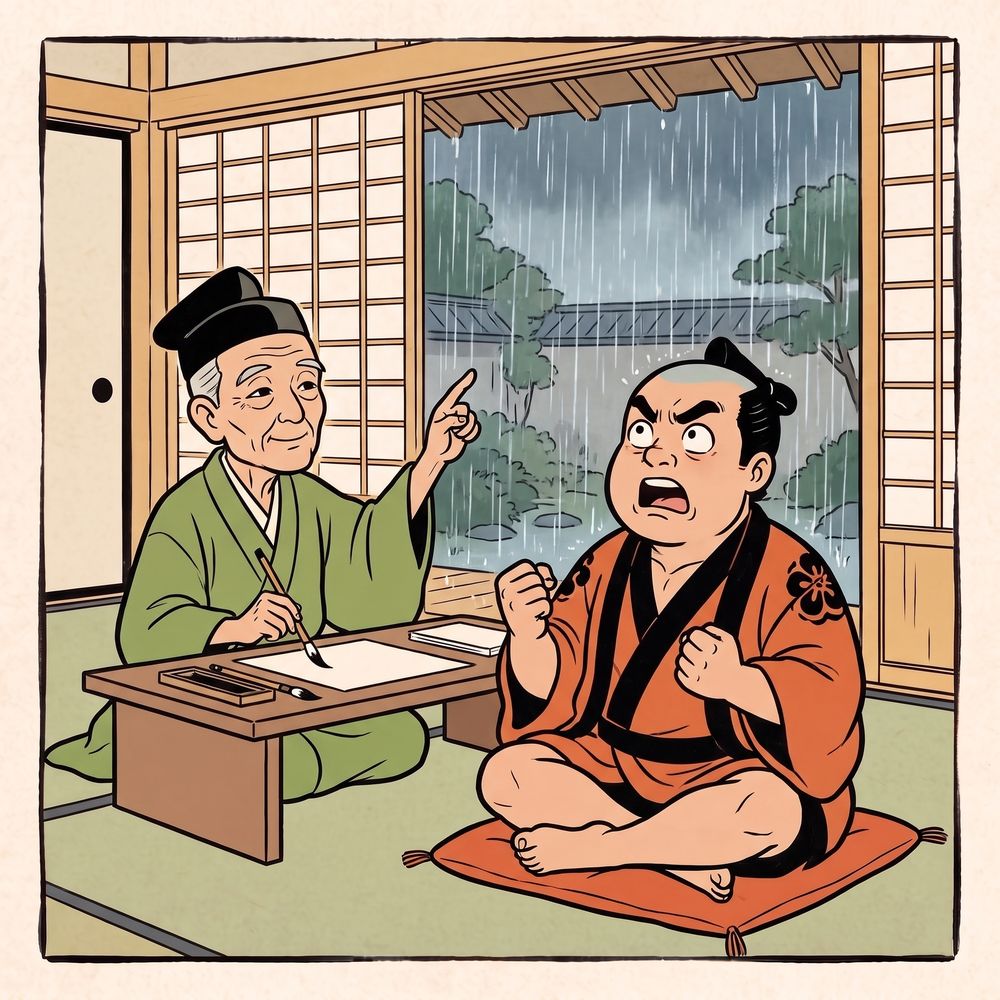
A man in the tenement who lashes out at the slightest provocation is sent by the inkyo, the retired elder, to see a teacher of shingaku, a popular moral philosophy. However angry you get, the teacher explains, you can't pick a fight with heaven, so whatever heaven does, you must simply accept. The man is deeply impressed. On the way home he finds a friend in the middle of a quarrel and immediately launches into his freshly learned sermon...
The story
In a certain tenement lives a man with a short fuse who is always punching people. Unable to stand by any longer, the inkyo writes a letter of introduction and sends him to a shingaku teacher. The teacher first tries to reason with him using proverbs, but none of it gets through.
So the teacher turns to examples. What would you do if a shop boy splashed you with water? If a roof tile fell on you? The man answers that he'd hit the boy and the shop owner too, and that he'd hit the owner of the house. Then what if you were caught in a sudden downpour in an open field? Would you pick a fight with the sky? Even this man has to admit he can't fight heaven.
The teacher explains that misfortune sent by heaven is called tensai, an act of heaven, and that you should treat anything that makes you angry as heaven's doing and let it go. Thoroughly impressed, the man heads home.
Back at the tenement, a friend's household is in an uproar. The friend had taken a woman into his home, and then his ex-wife came back and made a scene. Garbling the proverbs he just learned, the man lectures his friend that he should treat it as tensai and accept it...
The sage the punchline, contains spoilers
Tap to reveal the punchline
“Tensai? Nah, in my case it's sensai. My ex-wife.”
The sage (the punchline) is a pun on tensai, “act of heaven,” and sensai, “former wife.” The joke is that the friend's reply makes perfect sense, since the trouble really was caused by his ex-wife. Performers each find their own ways to play the earlier scene where the man mangles the proverbs.
Stories of half-learned lessons
A character who repeats what he's been taught word for word in front of others and fails is a classic rakugo pattern. Comparing Tensai with other stories of the same type brings out the flavor of its parroting.
| Story | What gets taught |
|---|---|
| Tensai | From a shingaku teacher, the wisdom of accepting what heaven does |
| Dokan | From the inkyo, the tale of Ota Dokan and the yamabuki poem |
| Tsuru | From the inkyo, how the crane got its name |
| Kohome | From the inkyo, how to flatter people and praise babies |
| Aona | Refined witticisms picked up by watching an elderly couple at a fine house |
Key scenes original dialogue written for this site
A dialogue of examples
- TeacherSuppose you're walking down the street and a shop boy splashes you with water. What do you do?
- ManThat's easy. I knock the kid flat, and while I'm at it, I punch his boss too.
- TeacherThen suppose you're out in a field and get drenched by a sudden rain.
- ManWell... I can't exactly punch the sky.
The lesson of tensai
- TeacherThat is tensai, an act of heaven. When something angers you, think of it as heaven's doing, and let it go.
- ManI see. You can't file a complaint with heaven.
Parroting at the tenement
- ManListen. A short temper is... what was it. Anyway, if the bag tears, you sew it up.
- FriendWhat are you even talking about?
This is not a transcription of any storyteller's performance. The plot and the sage follow the classic version. The dialogue was written for this site.
Notable performers
- Shunputei Ryukyo VI1899–1979EdoKnown as a performer who excelled at this story.
- Yanagiya Kosan V1915–2002EdoOne of the performers whose recordings survive.
- Tatekawa Danshi VII1936–2011EdoOne of the performers whose video recordings survive.
- Yanagiya Kosanji X1939–2021EdoOne of the performers whose recordings survive.