ShibahamaShiba Beach
芝浜(しばはま)
Katsu is a skilled fishmonger who has drunk himself out of work. At dawn on the beach at Shiba, he finds a wallet full of money. He calls his friends over for a huge drinking party, and the next morning his wife tells him, “What wallet? You must have dreamed it because you wanted money so badly.” A heartwarming story of husband and wife, often performed at the end of the year.
The story
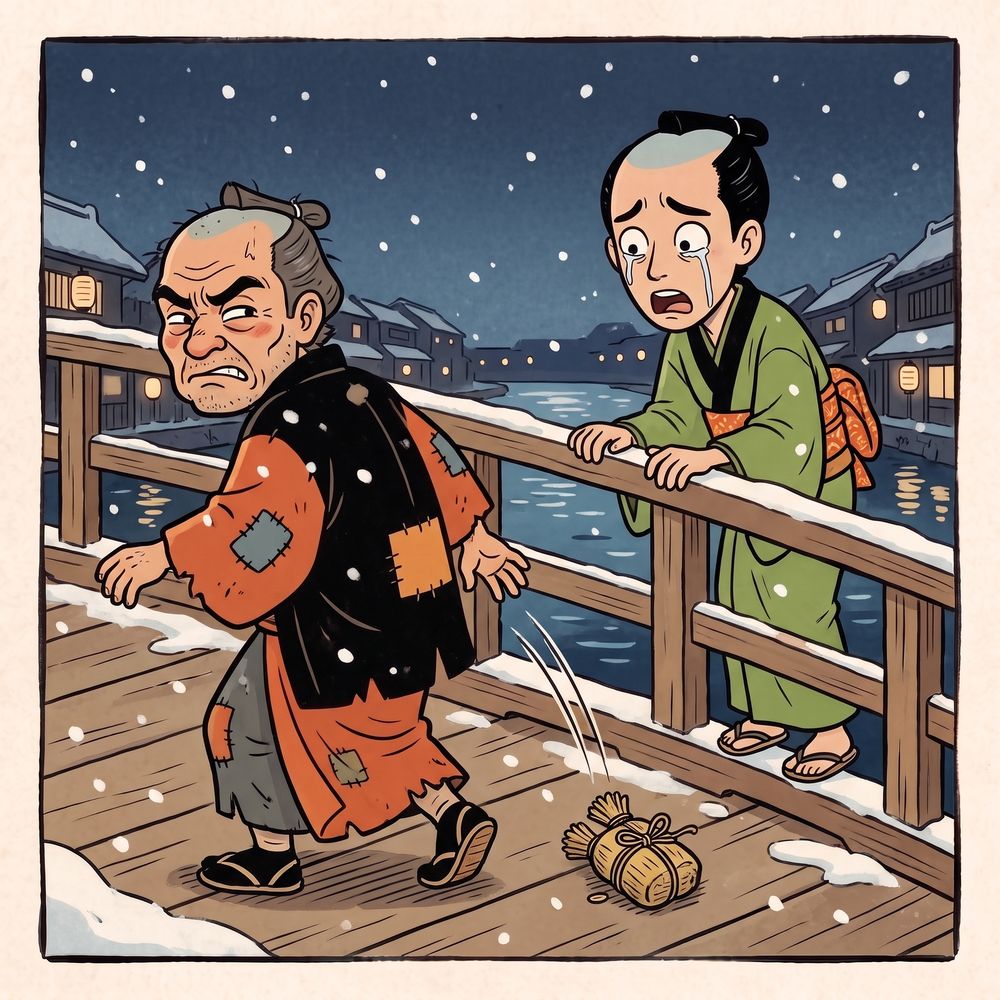
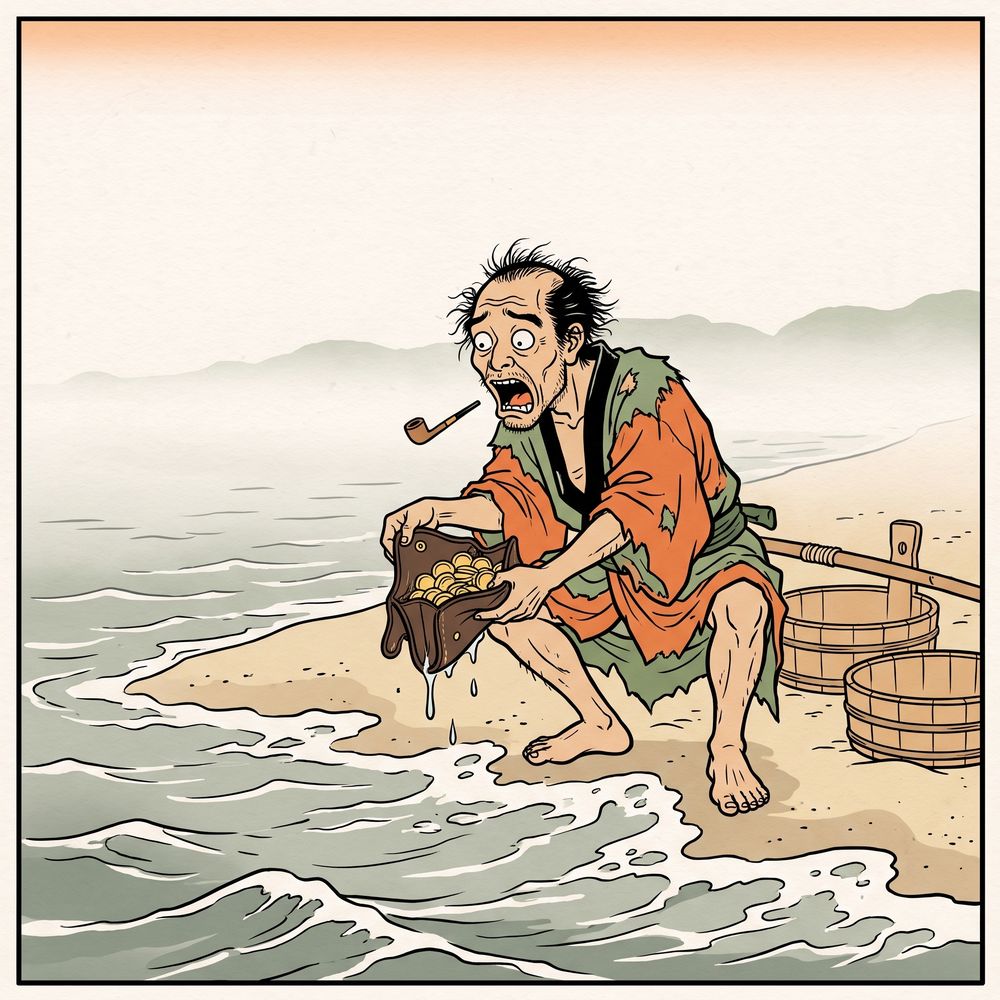
Katsu peddles fish from baskets hung on a shoulder pole. He's good at his trade, but he's sunk in drink and hardly ever works. One morning his wife hounds him out of bed, and he trudges off to the fish market at Shiba, only to find it's too early and the market isn't open yet. On the empty beach he washes his face and has a smoke, and then he spots a leather wallet lying in the shallows at the water's edge.
Inside is more money than he has ever seen. Katsu races home, invites his friends from the tenement, drinks enormously and falls asleep. But the next morning his wife says, “What wallet? I don't know anything about a wallet. You wanted money so badly you must have dreamed it.” They search the whole house and find nothing. Ashamed of himself, Katsu swears off drink for good and starts working like a new man.
Three years pass, and Katsu now runs his own shop on the main street. On New Year's Eve of that year, his wife brings out the wallet and confesses that it was no dream. She had been afraid that spending found money would be a serious crime, so after talking it over with the landlord, she turned it in to the authorities and convinced Katsu it had all been a dream. No owner ever came forward, and the money had long since been handed back to them.
Far from blaming her, Katsu bows his head and thanks her for getting him back on his feet. His wife suggests that, after all this time, he might have a drink. Katsu hesitates, then takes the cup and raises it to his lips...
The sage the punchline, contains spoilers
Tap to reveal the punchline
“No, I'll pass. Wouldn't want this to turn into a dream too.”
Three years ago, something real was turned into a dream for him; now he sets the cup down rather than risk his present happiness becoming a dream as well. This is a classic example of a sage (the punchline) that ends the story on a quiet, moving note rather than a laugh. The tone of the whole piece changes depending on whether the performer portrays the wife as a wise, capable woman or as someone who weeps and apologizes for having deceived him.
To show the beach, or not
After World War II, the version polished by Katsura Mikisuke III won acclaim, and the story became widely known as a masterpiece. Even so, performers differ quite a bit in how they handle the beach scene and how they portray the wife.
| Performer | The beach scene | Notes |
|---|---|---|
| Katsura Mikisuke III | Paints the dawn beach like a picture | His own staging, which works in a haiku by Basho near the opening. Won the Arts Festival Encouragement Prize in 1954 |
| Kokontei Shinsho V | Not shown | Katsu rushes home and tells his wife how he found the wallet |
| Kokontei Shincho III | Not shown | Like Shinsho, conveys what happened on the beach through Katsu's own telling |
| Tatekawa Danshi VII | Kept brief, sometimes cut | Portrays the wife as a humble woman who weeps and apologizes |
| Kamigata | The setting moves to the beach at Sumiyoshi, and the story is performed under the title Yume no Kawazaifu | |
Key scenes original dialogue written for this site
The beach at dawn
- KatsuWhat the... there's nobody here. She got the time wrong and woke me up too early.
- (He splashes his face with seawater, puts his pipe between his teeth and gazes at the sea. Then he glances down at his feet.)
- Katsu...Hey, there's a string sticking out. What's this? Well, I'll be. A leather wallet.
The next morning
- KatsuHey, where'd you put that wallet from yesterday?
- WifeWallet? What are you talking about? You came home, started drinking and passed out.
- KatsuBut... so you're saying it was a dream?
New Year's Eve
- WifeDear, please hear me out without getting angry. You remember this wallet, don't you?
- Katsu...That's...
- WifeThat morning wasn't a dream. I'm so sorry I lied to you all this time.
This is not a transcription of any storyteller's performance. The plot and sage follow the classic version; the dialogue was written for this site.
Notable performers
- Katsura Mikisuke III1902–1961EdoPolished this story after the war and became known as “Mikisuke of Shibahama.”
- Kokontei Shinsho V1890–1973EdoPerformed a version that skips the beach scene and lets Katsu tell it himself.
- Tatekawa Danshi VII1936–2011EdoTook issue with Mikisuke's version and kept reworking details such as how the wife is portrayed.
- Kokontei Shincho III1938–2001EdoOne of the performers whose recordings and videos survive.
- Hayashiya Tsuruko1987–EdoIn 2021 she premiered a Shibahama retold from the wife's point of view.