Daiku ShirabeThe Carpenter’s Trial
大工調べ(だいくしらべ)
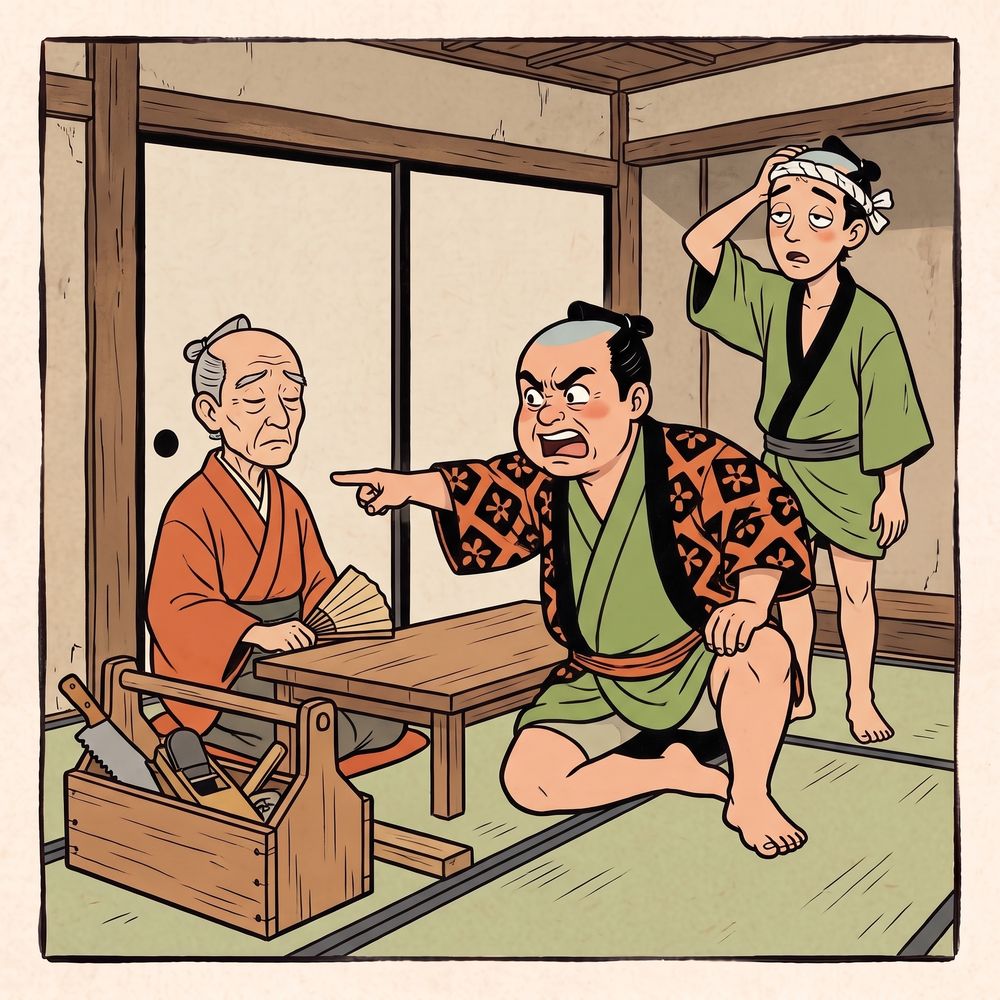
Yotaro the carpenter has stopped coming to work. When Masagoro, his master carpenter, goes to see him, he learns that the landlord has seized Yotaro’s toolbox as security for his unpaid rent. Masagoro gives him money and sends him to get it back, but the landlord will not give it up because the payment is just 800 mon short. Even bowing low gets them nowhere, and at last Masagoro’s patience snaps...
The story
Yotaro the carpenter is not bad at his work, but he is a bit of a dreamer. For days now he has not shown up for work. His worried master carpenter, Masagoro, goes to his tenement and finds out that the landlord has taken Yotaro’s toolbox as security for the rent he owes: one ryo, two bu and 800 mon.
Without tools, a carpenter cannot work. Masagoro hands Yotaro the one ryo and two bu he has on him and sends him off, saying, “Surely the landlord can wait for the other 800 mon.” But the landlord refuses to return the toolbox because the money is 800 mon short. Worse, Yotaro repeats Masagoro’s words to his face, and the landlord takes offense completely.
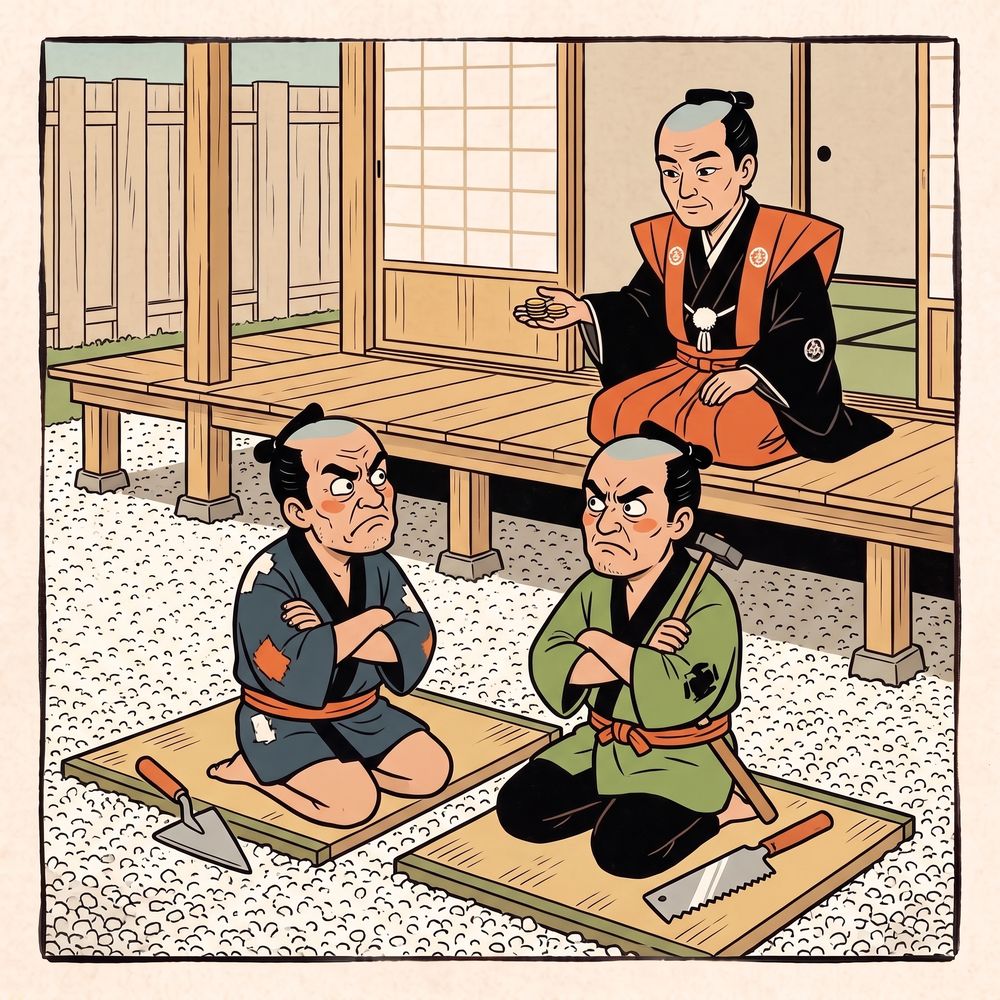
Next, Masagoro takes Yotaro to the landlord’s house himself and bows politely. Still the landlord will not agree, and he keeps talking down to them. Finally Masagoro loses his temper and unleashes a spirited tirade about everything from the landlord’s shady past to the way he treats people every day. Most performers end the first half around here, when Masagoro declares, “I’ll take this to the authorities,” and storms out.
In the second half, Masagoro files a complaint with the South Magistrate’s Office. First the magistrate rules that Yotaro was in the wrong for falling behind on his rent, and orders Masagoro to pay the missing 800 mon. Just as the landlord breathes a sigh of relief, the magistrate asks him, “Do you hold a pawnbroker’s license?”
Taking goods in pawn without a pawnbroker’s license is against the law. The magistrate has the toolbox returned at once. Then, to make up for keeping the carpenter from work for twenty days, he orders the landlord to pay Yotaro twenty days’ wages: 200 monme of silver. That is quite a profit on a debt of 800 mon. When the magistrate turns to Masagoro...
The sage the punchline, contains spoilers
Tap to reveal the punchline
“Yes, sir. A carpenter has his master. Now, behold the trial.”
The sage (the punchline) when the story is told to the end. It twists a craftsman’s stock phrase, “Saiku wa ryuryu, shiage wo goroujiro” (“there are many ways to do the work, so judge me by the finish”). Saiku (craftwork) becomes daiku (carpenter), ryuryu (many ways) becomes toryo (master carpenter), and shiage (the finish) becomes shirabe, the magistrate’s questioning in court. The “shirabe” in the title also means this courtroom trial. In some performances, the magistrate says “A carpenter has his master, after all,” and Masagoro answers, “Behold the trial.”
The First Half and the Second Half
The best-loved part is Masagoro’s tirade at the end of the first half, and the story works as a complete piece even if it stops there. That is why it is not often told all the way through. But the courtroom scene that the “shirabe” of the title refers to, and the punning sage, are both in the second half.
| First half | Second half | |
|---|---|---|
| Content | For Yotaro, whose toolbox was taken, Masagoro negotiates with the landlord and unleashes a tirade | In the court of the South Magistrate’s Office, the magistrate judges the landlord |
| How often you can hear it | Often performed at yose (variety theaters) and rakugo shows | Few performers tell the whole story |
| How it ends | Stops around the point where Masagoro says he will go to the magistrate and storms out | Ends with the punning sage, “A carpenter has his master, behold the trial” |
Key scenes original dialogue written for this site
The master carpenter’s visit
- MasagoroHey, Yota, why haven’t you been coming to work? Are you sick?
- YotaroI feel fine. My toolbox just went out to visit the landlord.
- MasagoroIt didn’t go visiting. He took it for the rent, didn’t he?
Bargaining with the landlord
- MasagoroSir, he’ll work and pay back the other 800 mon, I promise. But without his tools, he can’t work.
- LandlordIf it’s even one mon short, I can’t hand it over.
- YotaroBut the master said 800 is nothing to worry about.
- (Masagoro hastily tugs at Yotaro’s sleeve, and the landlord turns his face away in a huff.)
The master carpenter’s tirade
- MasagoroI’ve kept quiet, and you’ve gotten full of yourself. I came to you humbly, and you treat us like bugs.
- MasagoroEveryone in this neighborhood knows how you drifted into this tenement. Where’s the law that says a craftsman’s hands must sit idle over 800 mon or so?
- MasagoroFine. If that’s how it is, I’ll take this to the authorities. Yota, we’re going.
This is not a transcription of any storyteller's performance. The plot and the sage follow the classic version. All lines were written for this site.
Notable performers
- Kokontei Shinsho V1890–1973EdoOne of the performers whose recordings survive.
- Yanagiya Kosan V1915–2002EdoOne of the performers whose transcribed performance of this story appears in a published collection, Koten Rakugo: Kosan Shu (Chikuma Bunko).
- Kokontei Shincho III1938–2001EdoOne of the performers whose recordings survive. A transcript of his performance also appears in volume 6 of Shincho no Rakugo (Chikuma Bunko).
- Yanagiya Kosanji X1939–2021EdoOne of the performers whose recordings survive.